Waves have a staggering number of plugins overall and a lot of options for one of the most common tasks in audio mixing in EQing. After using a large variety of Waves plugins for years, I thought I’d offer my pick for best Waves EQ for vocals to use in your next mix.
Best Waves EQ For Vocals

While I know there’s a lot of love for a channel strip combo or their dedicated SSL EQ, I like the sound and versatility of their H-EQ Hybrid Equalizer.
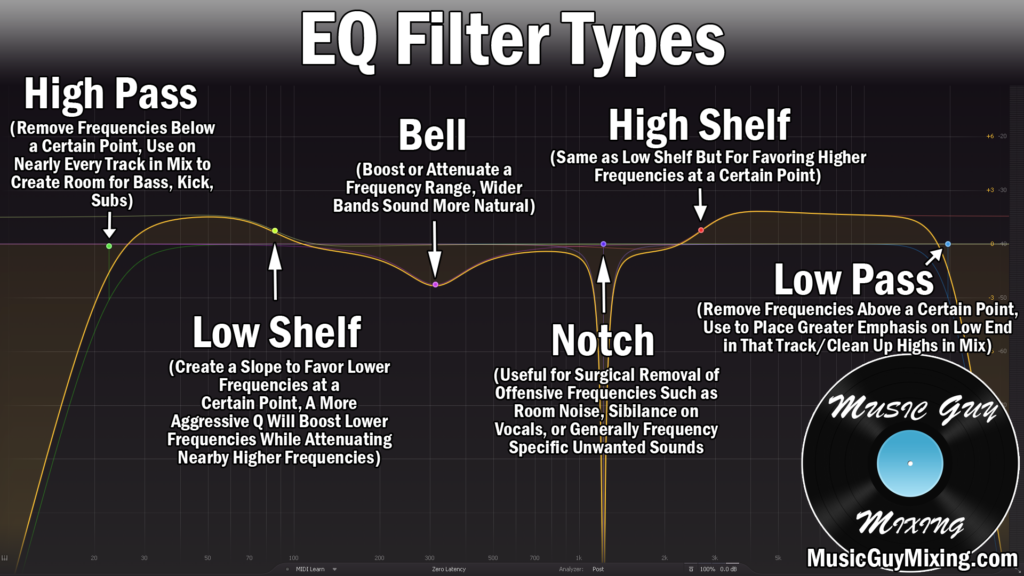
This plugin has a lot of the standard features you’d expect to find on a semi-parametric EQ. It’s got your high and low pass filters surrounded by 5 band specific filters. The low and high filters can be swapped between low shelf and high shelf shapes and bell shapes.
In between, the three center bands are all bell shapes, though you can adjust their Q settings as necessary to skew for a more narrow or wide adjustment:

It’s important to note that more recent versions of this plugin feature mid/side EQ exclusive processing, meaning you can just EQ the center, left, right, both, or all areas of your audio with respective to the stereo field.
I believe they also removed what is basically a redundant feature in the “Smooth” parameter which just helps to remove artifacts and noise during band automation (something which should generally be ticked when using it).
Also note that there is a “Lite” version of the plugin which is meant to be easier on the CPU load and is identical save for a few missing features. These include the analog harmonic distortion which you can add via the three controls in the lower right, including the flavor of the distortion from the dropdown menu.
It also doesn’t give you the “Analyzer” controls. So while you have the up to 7 adjustment points visualized, you don’t see the audio’s waveforms across the frequency spectrum illustrated in the Light version.
The analyzer is nice for seeing the frequencies you can’t always hear, especially on the lower and higher ends. The output is useful for showing the before and after impact of the adjustments you’ve made to see the new peaks, post gain tweaks.
I know there’s a lot of love for the more recent Renaissance EQ (REQ) which is another semi-parametric offering, but the real “sauce” of the H-EQ for me is in its ability to give you 7 different console emulating flavors for each band.
These include a US Vintage and Modern, two UK Vintage and a modern, and two digital options. These impart some of that analog sound to each adjustment you make rather than simply cutting or boosting a frequency.
If you just want the cleanest EQ possible, this isn’t going to be what you’re looking for, but I love it on vocals when I want that extra character.
Above pictured is actually my preset which I use when using the H-EQ on vocals. The snapshot shows each band’s frequency target, gain adjustment, and EQ type, but a quick rundown on each so you can apply it in your mix when using the best Waves EQ for vocals:
High Pass at 100Hz (Digital 2)
High passing your vocal removes unwanted noise and creates space for the low end of your mix (see low end mixing). It’s important to low pass your vocals like any other track in your mix. The digital 2 setting is clean and creates the perfect shape to transparently roll off those lower frequencies.
1-2dB Boost at ~230Hz (US Vintage)
I like a small 1-2dB boost around 230Hz for bringing out the body of the vocal. The US vintage is especially warm without getting cumbersome and does a nice job in adding that extra fullness that we’re typically looking for to anchor our vocal in this spot.
1-2dB Cut at ~500Hz (US Vintage)
I like a 1-2dB cut around 500Hz for cleaning up the vocal. This simultaneously attenuates some of the less flattering frequencies where reflection buildups occur. The US vintage setting once again works well here to add some desirable warmth while carving some of the vocal’s stuffiness out.
<1dB Boost at ~1200Hz (UK Modern)
I like a small boost under 1dB around 1200Hz to bring out more of the character of the vocal. Note that this is an important area to control a couple issues in the form of vocal nasalness or hollowness with a cut or boost, respectively. I talk more about this in my overall guide to vocal EQ, so refer to that for more information. The UK modern sits between the US vintage and US modern in terms of a warm vs cleaner tone and works best in this very subtle boost.
1-2dB Boost at ~3500Hz (US Modern)
For a little more bite, clarity, and a bit of punch on top of that, try a 1-2dB boost around 3.5kHz using the cleaner US modern setting. This can help put your vocal above the instrumental, particularly when you’ve got the vocal’s level set where you want it otherwise but it’s still missing that subtle something.
2-3dB Boost at 10000Hz (High Shelf – US Vintage)
The last move of note is a relatively stronger 2-3dB boost around 10kHz. This takes the form of a high shelf, so make sure you toggle the EQ shape button for this band to set it to high shelf if it’s not there already. I find the comparatively darker US vintage setting pairs nicely with this adjustment. Something about the character of the flavor helps to smooth out the top end punch, air, and crispness that we’re aiming for by way of the relatively sizable boost.
Low Pass at ~18kHz (US Vintage)
I like the shape of the US vintage band for the low pass to roll off the top of the vocal around 18kHz. If you want to be more conservative, aim for 20kHz.
Analog Distortion <100% (US Vintage)
This last setting is that aforementioned analog harmonic distortion which is exclusive to the standard (not Lite) version. This helps the EQ assert more of its unique character over the tone of the vocal.
Experiment with the different settings (all of the aforementioned options minus the two “Digital” settings), but I typically opt for US vintage.
The “Level” adds some noise which replicates that which you get from analog hardware. I typically leave this off/at 0%. I liken this to the “Analog” setting that some of my favorite Waves compressors feature; it just adds unwanted noise to me.
The THD Level is the parameter you want to turn up to hear the harmonic distortion.
“Feel” might be the better word like so many of the best subtle touches in mixing as I recommend setting this to somewhere sub 100% (it’s important to recognize that it goes all the way up to 1000%). I find anywhere below 100% keeps the distortion subtle enough that the listener won’t notice it but they’ll feel its contribution to the vocal.
Try replicating the above settings on your next vocal using my pick for the best Waves EQ for vocals in their H-EQ to get the functionality of a semi-parametric with the audible analog touch of a console or hardware.