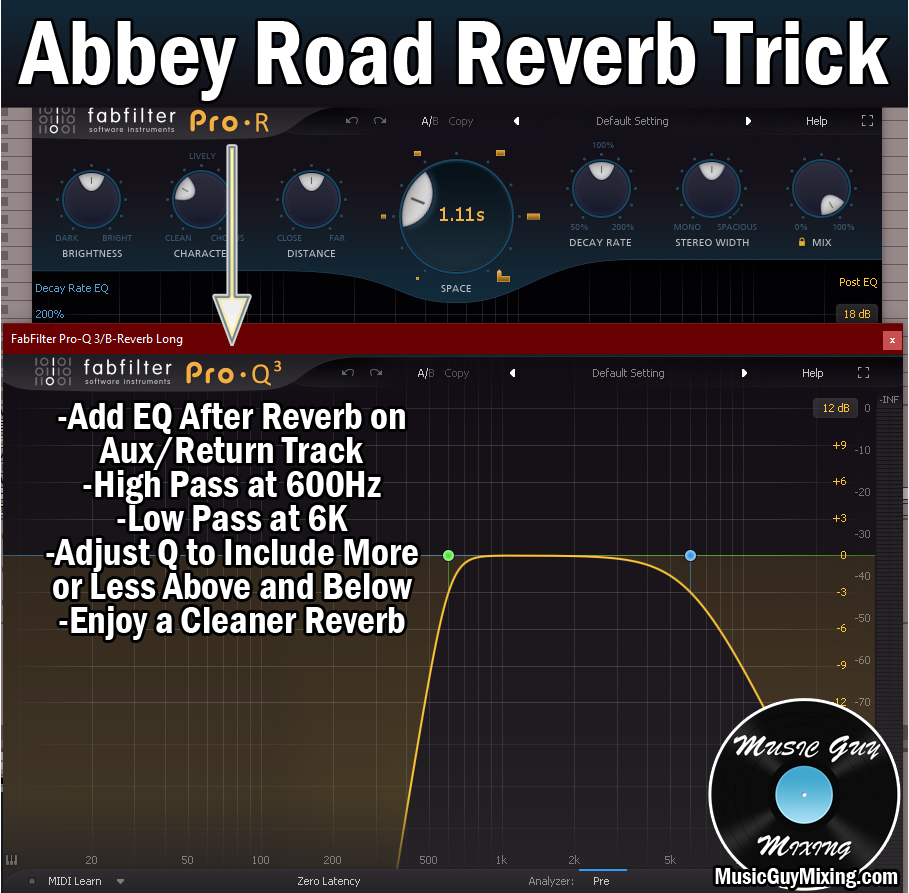
Normally when I talk about reverb on this site, it’s rarely in the context of low frequency instruments. That said, I find that reverb on bass guitar can work in the mix when used effectively and just as importantly, when used responsibly. Let’s talk how to use reverb on bass guitar including the settings I recommend which you can try and work into your bass guitar in your next mix for some surprisingly pleasing results.
How to Use Reverb on Bass Guitar

First, I should mention that one option in using reverb on bass guitar is when you’re applying it across the entire mix uniformly. In this case you’d drop an ambience reverb plugin on the mix or master bus which brings a kind of cohesion to everything by making it sound like it was all recorded in the same space.
Obviously in this situation it’s being applied to the bass guitar, as well. It’s generally still a good idea to high pass filter that reverb to remove everything below that 500 or 600Hz range, especially when you’re applying it to everything in the mix including those low end heavy instruments like bass guitar.
This helps to keep a cleaner mix, not to mention reduce the chances of a muddy mix.
To that end, you also want to keep the Wet/Dry blend on that ambience reverb on the main bus low, under 10%.
This is another one of those “feel” more than hear effects as we really just want that tiny push of cohesion which we get out of it while allowing any reverb we have on the tracks themselves to assert the depth for the listener.
Aside from that, regarding a dedicated reverb on bass guitar, we can go a bit higher on the Wet/Dry blend or the amount you’re blending in by way of an Aux/Return track when using it as an aux send.
While I’ll typically use an Aux/Return track when applying the same reverb to multiple tracks, like in the case of my vocal reverb, sometimes I’ll just drop it at the tail end of my bass guitar effects chain as an insert.
Predelay
I’ll typically start with a predelay of about 20ms on my bass guitar reverb.
This is the setting which creates a little space between the dry sound and when you actually hear the effects of the reverb.
Somewhat similar to the attack on your bass compression, you want to create a little delay for those initial transients to come through without being yanked down with the rest of the compressed sound or, in the case of reverb, without being colored by the sound of the reverb until we’ve heard that initial punch.
The punch on the bass guitar comes from a combination of the strings and fingers or pick on them. It’s that percussive sound which helps the bass cut through and assert itself in the mix, a sound we don’t want to dampen by way of the reverb.
Thankfully the transients don’t need much time to assert themselves in a meaningful way, and 20ms of predelay on the reverb acts as a sweet spot where we get the best of both worlds.
I’m basing this around a tempo of roughly 120BPM, so you may need to increase this if your BPM is slower than that, or decrease it if it’s faster. You should also experiment with each of these settings to find what works best for your mix, but they’re all great places to start.
Time
I like to aim for around 1.5 seconds (1500ms) for the time/decay. Different reverb plugins refer to this as different things, but this is effectively the duration or length of the sound of the reverb itself.
Again, this is roughly based on a 120BPM. If you want to get precise, you can set the length to a note length as it relates to your songs BPM.
This may seem like a lot, but you can always turn down the blend amount by way of the Wet/Dry.
EQ
I alluded to this earlier, but I like to high pass my reverb on bass guitar to help clean up its tone and keep it from getting washy or muddy down in that fundamental frequency range.
This is the range where the frequencies of the majority of the notes actually exist:

We want this range as clean as possible, hence high passing the reverb so none of the sound of those reflections are on the notes in their fundamental range.
I actually like to high pass around 600Hz so the reverb begins just above that boxy range as labeled above.
Normally I low pass around 6kHz to keep the reverb out of the high end, but in the case of reverb on the bass guitar I actually like a little high shelf around 6kHz to boost up that punchy, crisp, metallic end of the bass.
This helps give the bass a little high end sparkle which can help the bass sit better around the rest of the mix on the higher end.
Wet/Dry
This, like the “color” of the reverb, is entirely to taste and what works best will vary from one mix to the next depending on the vibe. As mentioned before, you can get away with going higher than the 10% and below I recommended for a universal, mix-wide reverb.
This is especially true as we’ve passed the reverb above the most important frequency range on the bass, so turning this up will shine a light on and allow the clarity ranges of the bass to occupy more of the mix which tends to work very well in a lot of mixes I work on.
Simply experiment until you find that perfect blend on the wet/dry, and don’t forget to check out my entire bass chain to see how to mix bass top to bottom with just the right settings on EQ, compression, and more.