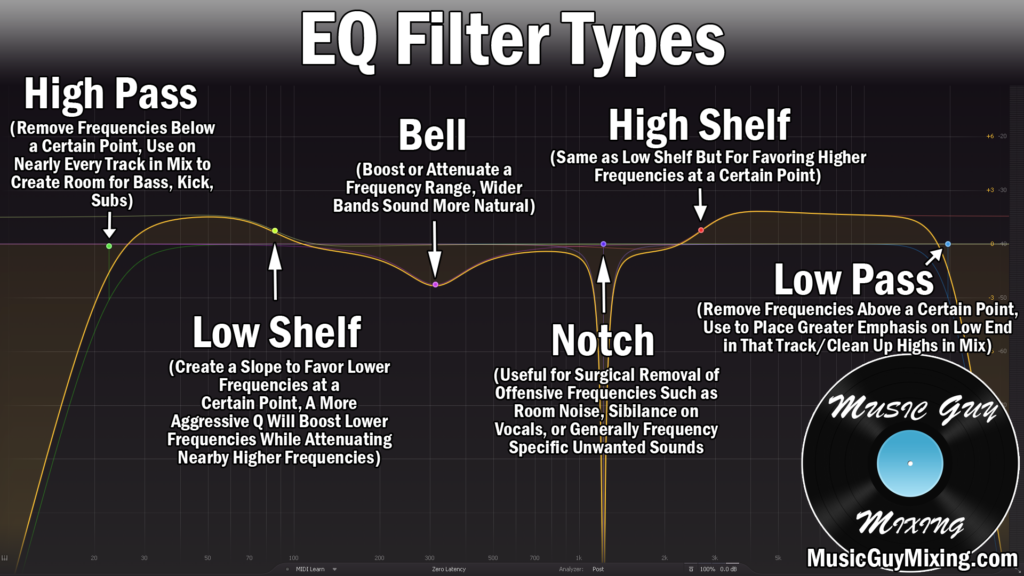
I say this all the time, but the kick drum is the anchor of the mix, and this is doubly true in a genre like techno which especially revolves around the kick and the role it plays in the mix. Therefore it’s crucial to get it sounding it’s best and it’s wise to begin with your kick and specifically begin with techno kick EQ.
While you’re likely using a sample, whether you’re using a sample or a live recorded kick, this techno kick EQ guide will detail how to emphasize or even augment the meat of the kick while carving and cleaning out the parts which are detracting from the overall sound.
Techno Kick EQ
Here is a snapshot of the techno kick EQ settings you’ll want to dial in as a baseline which will get your kick most if not all of the way there (though some frequency targets will range slightly from kick to kick, sample to sample):

High Pass at 20Hz
While high passing the rest of your mix is far more important for creating mixing headroom, not to mention creating space for your techno kick and bass, you can remove the frequencies which we can’t hear but nonetheless are eating into your headroom with a high pass at 20Hz.
I like a gentle to average slope EQ setting here, as well – aim for 12-18dB/oct for an efficient cut which doesn’t eat into the lowest end body of your kick.
As an aside, it’s important to make sure when you’re making adjustments that low on a track like the kick which has extremely low end frequency information that you can actually hear it. In the absence of a low end specific monitor, opt for mixing headphones for monitoring the lowest end of your kick or your mix in general.
Using a reference track to get a better idea of what you want the body of your kick to sound like can really help with that context, as well.
Boost Body at ~65Hz (Search)
The body of your kick is the meat of the thud; when I talk about your mix’s anchor, this is precisely what I’m referring to.
This typically peaks around 65Hz, though you can confirm this with an EQ plugin with a frequency spectrum visualizer (like my personal favorite, FabFilter’s Pro-Q).
Many producers opt to not only try a small 1-3dB boost as necessary in that body of your techno kick, but they’ll also supplement it with either a second kick sample or simply using the sine wave kick trick:
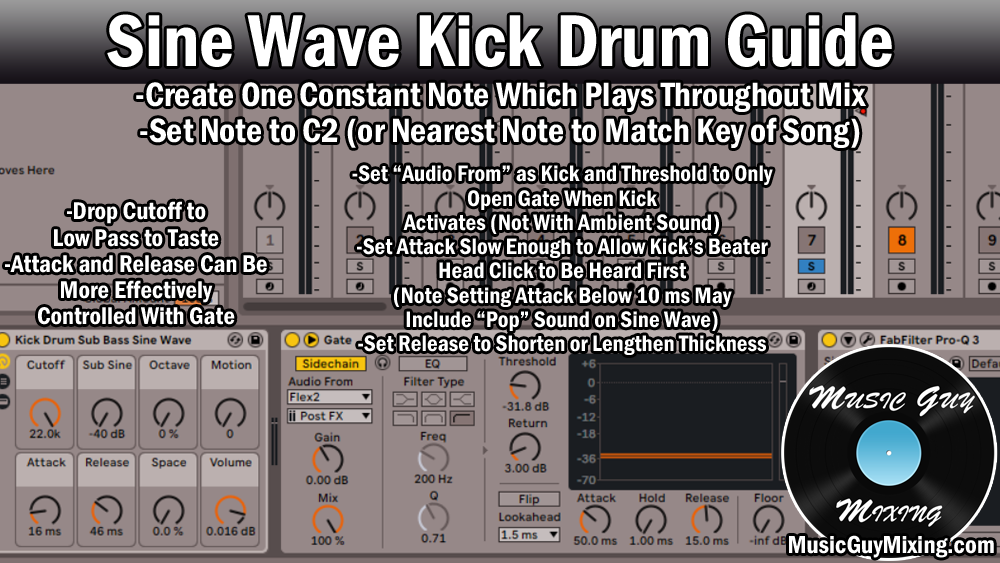
I’ve talked about this before, but the above image details the process of dropping a sine wave “instrument” on a dedicated track, essentially setting it at the frequency of your kick’s body (around 65Hz) and to play on repeat, then dropping a gate on it. The gate is then sidechained to your techno kick such that the behavior of the gate is controlled by that kick track. When the kick triggers, the gate opens and the sine wave is heard.
The level of the sine wave is then dropped so you feel it rather than hear it supplementing the kick and acting as more of that essential body of the kick.
This is a nice way to augment your kick’s body without even having to boost it via the EQ which itself doesn’t always pay dividends, depending on the sample or recording. You can even set that sine wave to be whatever key your song is in (in that nearest to 65Hz region).
Regardless, that 65Hz body of your kick is essential for grounding AND driving your techno mix, so either boost it or supplement it (or both) to taste.
Sidechain Cut (on Bass)
One of the keys to getting your techno kick sounding its best is to get it working and sharing the space with your bass.
The kick and bass share a similar or at least overlapping fundamental frequency range, particularly the kick and sub-bass which many techno mixes feature. Whenever two tracks share a fundamental space like this, it usually makes sense to pan them far off and against one another.
Unfortunately, both kick and bass/sub-bass best when front and center in the mix (sans panning or spacial effects), so it works well to take a complementary action, sidechaining one to the other so that one track ducks out while the other is playing.
Because the bass is the more constant playing of the two, particular with synth bass (see how to EQ synth bass), it works well to duck out the bass whenever the kick triggers for a split second.
I’ve put together guides on how to sidechain your bass to your kick; here is a snapshot on how to do it with a compressor on the bass:
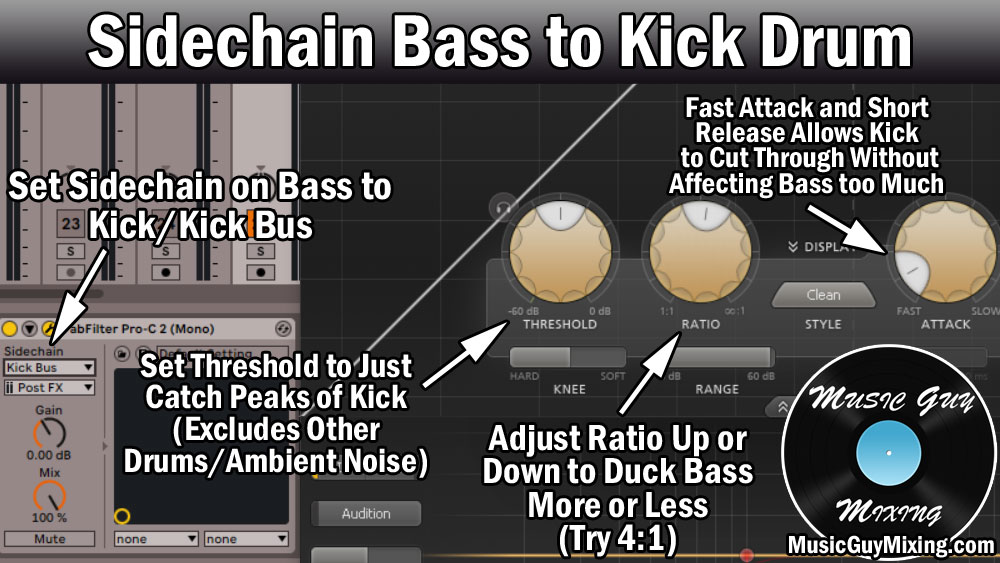
Essentially we’re just dropping a compressor on our bass and setting the sidechain to the kick. Now, similar to how we set up our gate earlier when talking about supplementing the kick with a low frequency sine wave, we’re telling the bass that the kick is again driving the behavior via the sidechain option, this time of the compressor on that bass.
Adjust the ratio and other settings as detailed above (though some slight tweaks may be required) and each time the kick plays, the bass gets out of the way for a few milliseconds – just enough for the kick to have that complete and invaluable dominion over the low end of the mix.
Note that you can do something similar with multiband compression or dynamic EQ (see how to use dynamic EQ in that way) to target and duck out just the shared fundamental frequency of the techno kick on your bass, but regardless this is a great way to clean up your low end.
Check out my additional tips on low end mixing to get what is arguably the most important region of your techno mix sounding its best.
You can also return the favor by ducking out around 150Hz on your kick when the bass triggers. This isn’t as essential as the kick is the less frequent, more staccato track, so experiment with this to determine if it benefits the low end of the entire mix.
Cut at 400Hz
Getting back to the techno kick EQ moves, I always love a cut around 400Hz to clean up some of the mud.
Not only does this clean up your kick, by way of subtractive EQ it places a greater emphasis on both the body and higher frequencies, adding weight and clarity simultaneously.
Best of all, it’s doing this without having to boost anything which, as a general rule, is always a better way of going about it (cutting versus boosting). It’s worth acknowledging in the same breath that sometimes a boost is extremely beneficial, like bringing out more of your kick’s transient punch.
Boost Around 3.5kHz
You’ll hear the clicky higher end percussive sound of the techno kick around 3.5kHz, and a small 1-2dB wide boost here can go a long way.
Not only does this add a bit of clarity, it helps the kick assert itself over the other elements of the mix when it triggers. This draws the listener’s ear to it by way of its audio transients which precede the sound, brief as they are.
Low Pass at 15kHz
You can safely low pass your techno kick around 15kHz without fear of losing any of the top end punch to create a modicum of headroom or space for your synths, cymbals, etc.
Techno Kick EQ Tips
- High pass your techno kick at 20Hz with a 12-18dB/oct slope to create headroom and remove inaudible frequencies.
- At roughly 65Hz for the techno kick’s body, boost it, supplement it with a gated sine wave at that frequency, or both to add weight to your kick.
- Make sure you can accurately monitor the lowest frequencies. Mixing headphones with a frequency response down to 20Hz can help, as can using a reference techno track for getting more context as to what you want your kick to sound like.
- Sidechain compress your bass to your kick so that when your kick triggers, the bass level gets ducked slightly. Sidechaining dynamic EQ to only pull the kick’s fundamental frequency out of the bass when the kick triggers can also work for more transparent results.
- You can optionally also do the same thing but on the kick around 150Hz, sidechaining that band to the behavior of the bass.
- Cut around 400Hz with a static or dynamic cut to clean up the boxiness of the kick, both cleaning it up and placing a greater emphasis on the body and punchy frequencies.
- Try a small 1-3dB boost around 3.5kHz to bring out more of the transient punch of the kick to keep it visible in the mix to the listener.
- Optionally, you can also low pass at 15kHz on the techno kick to create more headroom and space amongst the top end of your mix without sacrificing anything on the kick.