Whether your synth bass is being used to supplement or completely anchor the low end bass of your mix, make use of this synth bass EQ cheat sheet to get it sounding its best.
Synth Bass EQ Cheat Sheet
Here is the snapshot of synth bass EQ cheat sheet at a glance:
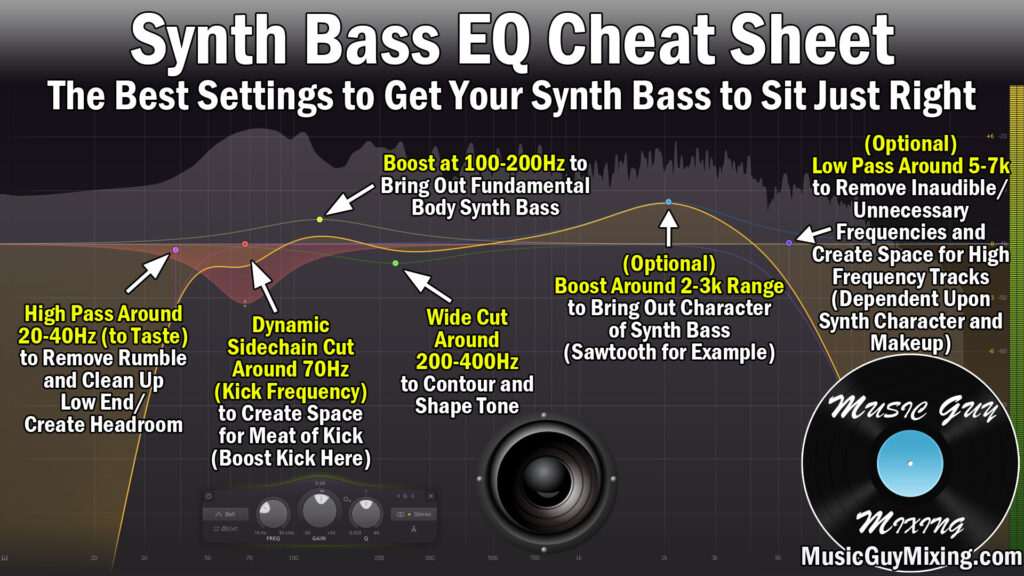
Some of these adjustments are optional, some of these adjustments take place between a wide range, so let’s cover each move in depth to better explain why I recommend what I do where.
High Pass Between 20-40Hz (Sweep)
The average listener can hear between 20-40Hz on the extreme low end, and while obviously the bass response of the equipment they’re listening on plays into it, you can still high pass up to 40Hz in order to create some mixing headroom to ultimately create a better sounding louder mix.
This also helps to remove unmusical rumbling that you get on the lowest end of some synth basses which doesn’t contribute to the sound that you want.
Just start at 20Hz using monitors or mixing headphones with a frequency response to pick it up and sweep up. As always, a good rule of thumb is to back off back down 10Hz when you hear the synth bass audibly change at all.
Dynamic Sidechain Cut at 70Hz (To Complement Kick)
Whether you’ve got a string bass or a synth bass, a complementary cut on the bass around the fundamental frequency of the kick drum can yield a cleaner mix.
I say this all the time when talking about getting the kick and bass to gel together – when you’ve got two instruments which share a similar fundamental frequency but CANNOT address space by way of panning, a sidechain cut can be the answer.
Refer to my guide to how to use sidechain EQ for more information, but essentially you create a band cut at 70Hz which is roughly the fundamental frequency of the thud that you hear with most kicks. Within your DAW and specific EQ plugin, you set the sidechain input for that band to be controlled by the kick.
When the kick triggers, the band pulls 70Hz on the bass down; the exact amount which gets pulled down is relative to where you put the threshold (which is obeying the level of the kick).
This rarely affects the bass, only pulls that the bass down when the kick triggers, and only affects that 70Hz range. This also creates space for the kick when it needs it, yielding a cleaner low end of the mix.
Boost At 150Hz (For Body)
The body of the synth bass can extend down to 40Hz up to around 200Hz. To give it a bit more thickness and body to form a better anchor without turning up its level needlessly, try a small and wide boost between 100-200Hz, centering in that 150Hz point.
1-2dB is plenty to get it to sitting a bit better and this is a safe spot to boost without worrying about getting in the way of the kick, as well.
Wide Cut At 300Hz
You can contour and shape the tone of the synth bass via your EQ with a 300Hz cut.
Likewise to the body boost, a nice wide cut between 200-300Hz works to carve out a bit of the muddiness to clear it up and create a pleasantly contoured sound which I typically appreciate in my synth bass in my mixes.
And likewise, just 1-2dB in that cut is enough to to create a little clarity by way of subtractive EQ, as well.
(Optional) Boost at 2.5kHz for Character
Depending on the type of synth bass you’re featuring in your mix, a boost of a decibel or so around 2500Hz can add some desirable character to your synth bass via EQ, as well.
Just a decibel or so boost can bring out the “teeth” of a sawtooth or help an average synth bass better assert itself in the mix, as well.
Low Pass Around 5-7kHz
The final synth bass EQ move is to roll off the inaudible top end of the synth bass to similarly create some headroom as we did on the low end. You can be much more liberal in how much you cut on the top end with your low pass filter.
This will vary greatly depending on your synth bass, but 5-7kHz often is a safe spot to roll off the top end without losing anything musical. An exception might be with a brighter leaning synth bass, like the aforementioned sawtooth with more of that grit on the top end.
In this case, you may need to sweep higher to preserve some of that punchy hiss you get on the top end, but with a typical, more rounded synth bass, you can oftentimes get away with as low as 5kHz to benefit the rest of the mix without losing anything.