High shelves and low shelves make for nice alternatives to the extremes of high and low pass filters on either end, and can also slot nicely midway in your frequency spectrum to provide a relatively even boost or cut. Let’s talk high shelf vs low shelf EQ in audio mixing and how the two differ from one another.
High Shelf Vs Low Shelf EQ

First, a shelf EQ filter in general is one of a few types of EQ which is a raised or lowered frequency span which resembles a shelf, whether that’s above or below a neutral 0dB position:
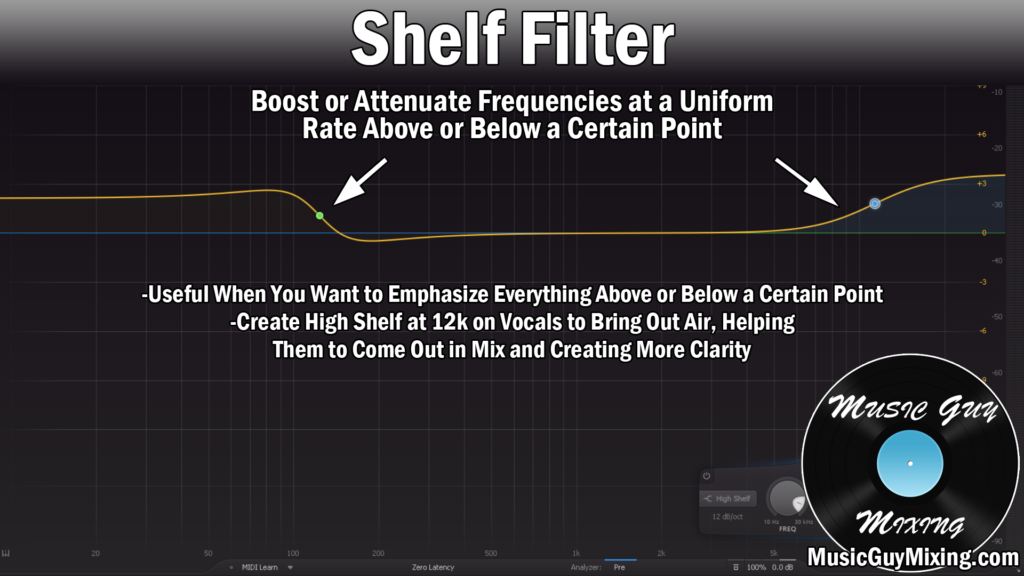
As the graphic explains, these shelves are for emphasizing or de-emphasizing everything above or below a certain point with a boost or cut, respectively.
A common misconception regarding high shelf vs low shelf EQ is that the former (high shelf) is for boosting and the latter (low shelf) is for cutting.
The reality in comparing high shelf vs low shelf EQ is that a high shelf affects the frequencies ABOVE a certain point whereas a low shelf affects the frequencies BELOW a certain point.
To illustrate the difference another way, let’s compare the two with their own graphics.
High Shelf EQ
In this example, I’m creating a high shelf EQ boost at 1kHz:

As the image suggests, the Q setting is what is driving the shape or grade of the curve:

Setting it to its max creates a stark contrast of cutting on one side of the point while boosting on the other (which side depends on whether it’s a high or low shelf, not to mention if you’re cutting or boosting).
Setting the Q to its lowest setting results in a smoother curve for that transition:

The Q isn’t the only parameter affecting it, however; the slope EQ setting likewise affects the severity of the shape or grade of the curve with a lower dB/oct resulting in a smoother transition versus a higher dB/oct.
High shelf EQ is arguably most commonly used when boosting the higher frequencies on a track.
I recommend a small high shelf boost in the upper range on a number of tracks in my EQ cheat sheet (which you can grab for free) as this adds a little subtle air and crispness which plays nicely and helps the transient punch across your mix without crossing over into a harsh territory.
Again, though – you can just as easily do a uniform or near uniform cut/attenuation ABOVE a certain point. There’s also no rules as to how low you can set your high shelf EQ adjustment at in terms of frequency. If you want to create a wide and uniform or near uniform adjustment at any point in your mix, you can theoretically use a high shelf.
Of course, at a certain point when you go low enough, it makes more sense to use low shelf EQ.
Low Shelf EQ
Compared to high shelf EQ, low shelf EQ is simply creating a bump up or cut down BELOW a certain frequency point.
Here I’m using TWO low shelves; one is cutting below around 1kHz with one low shelf, then I’m using another to boost starting around 85Hz:

All the same rules regarding the Q and slope apply to a low shelf adjustment, and likewise you can use a low shelf EQ adjustment to either cut OR boost below that point.
I mentioned how high shelf EQ is (arguably) most commonly used; regarding low shelf EQ I find myself using this with a cut in place of or just before a high pass filter.
This is useful when you don’t want to completely roll off the low end of your track but still want to attenuate it or otherwise clean up some of the mud and low end noise which isn’t contributing to your mix, simultaneously creating space for the low end instruments of your mix which need those frequencies.
The uniformity of the cut via the low shelf helps maintain the natural sound of the track, albeit attenuating the impact of that track’s low end.
The next time you reach for a high or low pass filter or even a typical bell shape EQ adjustment, try a small adjustment via a high or low shelf to achieve a more natural and overall better sounding result.