I just talked about what a compressor does for vocals the other day, pointing out that vocals especially need some control via compression due to their relative greater dynamic range. While not nearly as dynamic in most cases, guitar both acoustic and electric can benefit from some compression to help them sit better in the mix and ensure no notes are lost. This is especially true with picked, arpeggiated, or lead parts. No matter what kind of guitar you’ve got in your mix, let’s cover the best settings in how to compress guitar.
How to Compress Guitar

Let’s begin with electric guitar which, whether you’re playing chords or more of a riff or solo, will require different settings.
Electric Guitar Compression
Here is a snapshot of the best compressor settings for guitar:

These settings can be applied equally to chords or monophonic (single notes at a time) picked parts. Just note that, as the graphic shows, you’ll want to lower the threshold and raise the ratio for the latter in the case of a riff, arpeggio, etc.
The reason for this is that there’s generally a lot less dynamics or difference in the volume if you’re playing 20 chords in a row versus playing 20 individual strings in a row.
Threshold
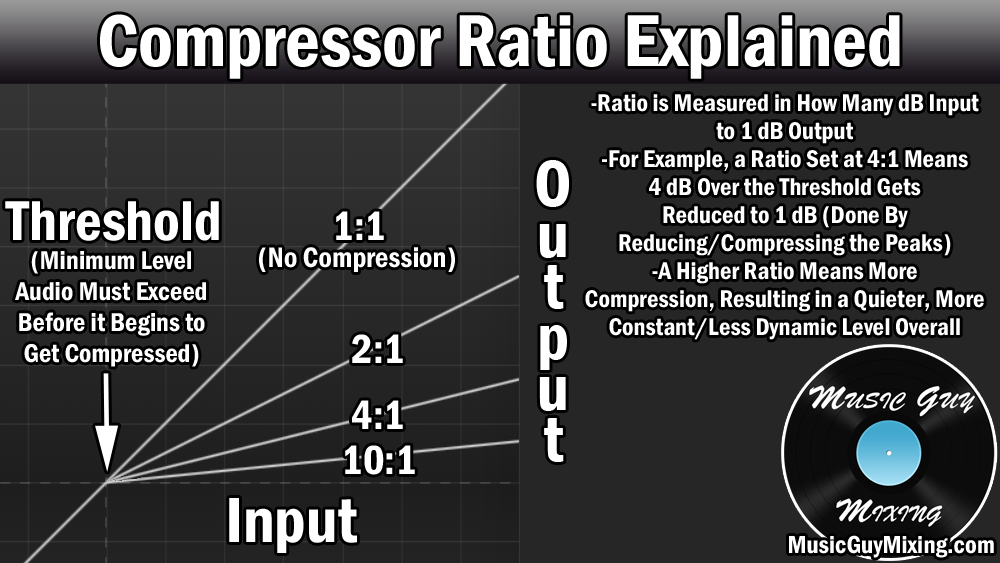
The threshold will dictate at what level the compression begins. In the case of chords, you can set this around the average level of the performance/track.
In the case of an aforementioned monophonic part, you’ll want to set this a bit lower to reduce the dynamics of the performance even more.
Ratio
The ratio deserves special treatment dependent upon the type of performance, as well.
In the case of chords, you can get away with a more conservative, lighter ratio of 3:1. This means every 3dB which exceed the threshold, they’ll be instead output as 1dB. In other words, you’re turning the peaks of the performance down by 2dB for every 3dB which exceeds the threshold.
With a monophonic part, one note at a time, you tend to get a lot more dynamic range between the quietest and loudest plucked notes.
I like to double up the guitar compressor’s ratio to 6:1 when compressing a riff, lead part, solo, etc. to ensure every note is well heard and represented in the performance.
Attack
5ms of attack offsets or otherwise delays the compression once that threshold is met to allow the initial transients of the guitar to come through. This is that percussive sound of pick (or finger) hitting the string which draws the listener’s ear to the rest of the note or chord.
A few milliseconds of attack ensures the guitar stays present in the mix as that initial punch comes through unhindered before the compression clamps down on the peaks otherwise.
Release
Once the threshold is no longer met, a 50ms release allows the compressor to gracefully disengage without any unwanted abrupt artifacts on the guitar. Likewise this ensures the compression doesn’t overstay its welcome and keeps the guitar sounding lively and natural.
Output
As always, make sure you offset the gain reduction which is achieved by way of attenuating the peaks through compression by turning up the output gain dial. Just make sure that when you split test by toggling the compressor on and off that the volume sounds roughly the same.
This ensures that, when you’re auditioning the sound of the guitar with versus without the compression, the louder option won’t automatically win out because both should sound the same from a volume perspective.
Acoustic Guitar Compression
Because of the nature of the electric guitar which is a product of the electronics (of the guitar AND amp when applicable) and strings, you tend to get a smoother and almost inherently more compressed sound than you get from the much rawer acoustic guitar.
As such, I generally recommend a slightly more aggressive approach when compressing acoustic guitar in terms of the threshold and ratio, but again, this comes down to the type of performance whether it’s fuller chords or individual plucked notes:

Threshold
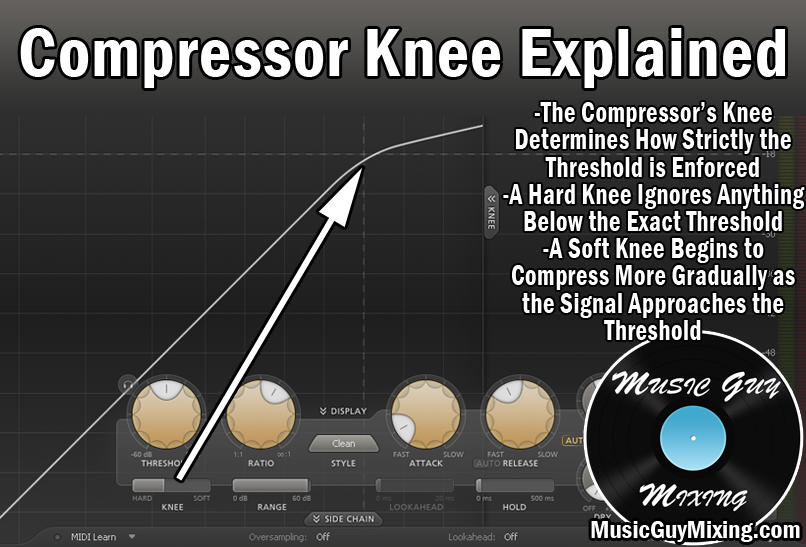
Speaking of threshold, I like to set this to roughly the quietest part of the performance. The compressor’s knee works with the threshold; essentially the lower/harder it is to 0dB, the more strictly that threshold is enforced.
With acoustic guitar, I aim for around a 12dB knee, meaning the acoustic guitar begins to get compressed at a lower ratio even before that threshold point is met. This results in a slightly more natural compression than the all-or-nothing approach of a harder knee.
Ratio
As you can see, I recommend a slightly higher average ratio of 4:1 when compressing acoustic guitar versus electric, at least in the case of chords.
Once again, I’d double this up for the case of a picked/plucked part on acoustic guitar as we don’t have that natural compression working, it’s just the finger or pick on string being picked up by a microphone in most cases (see how to record acoustic guitar).
An 8:1 ratio is an admittedly aggressive ratio, but it works well to attenuate the loudest notes and achieving a more average level to ensure the quietest notes aren’t lost. You can adjust this to taste as necessary to maintain more of the natural dynamics, but that 8:1 ratio works well to keep all notes visible.
Attack
You get more of that transient “bite” with the percussive sound of pick or finger on string with acoustic guitar than you do with electric guitar, and it’s important to preserve this to keep those notes visible.
A 25ms attack is admittedly very conservative and you can get by with an attack closer to the electric guitar, so adjust this setting as necessary to find the compromise which works best for your performance.
Release
Once again, a 50ms release helps to ease the compressor off once the threshold isn’t met. A 15ms hold can help to buffer that for a more natural off-ramp, as well.
Output
Once again, don’t let your ears get tricked into anointing the louder option as the winner when A/B testing with the acoustic compressor on and off. Set the output level to more or less match the volume without the compression to more effectively make final adjustments to the settings on your compressor.
As always, compression is just one of many aspects in getting the best from both your electric or acoustic guitar.
Check out my complete guides on how to mix electric guitar and how to mix acoustic guitars respectively to get them both sitting perfectly in your next mix.