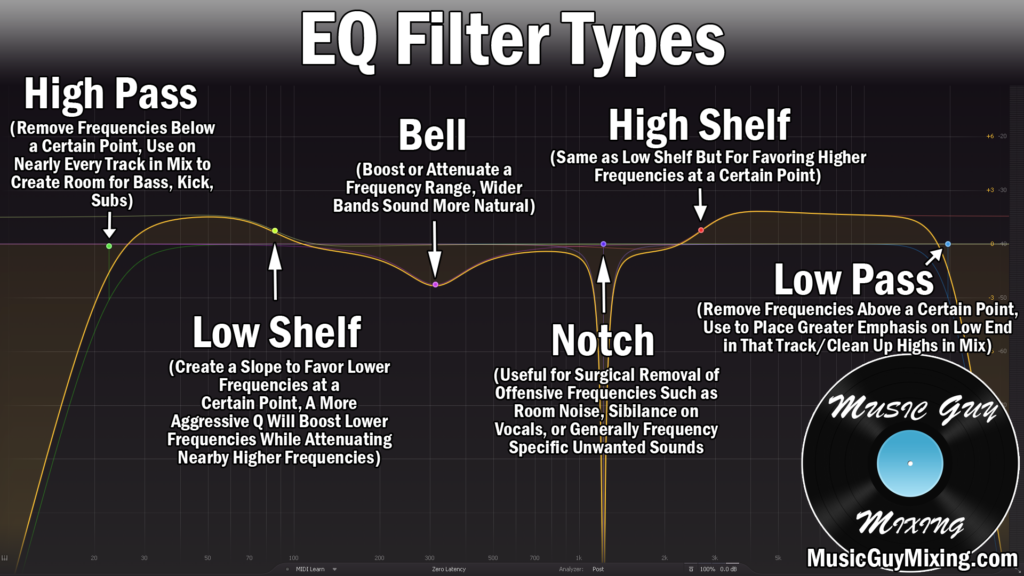
One of the best places to start when you sit down with a collection of recorded tracks for a song is the kick drum as this is the heartbeat and anchor of the entire mix. If the kick isn’t mixed properly or sitting right in the mix, everything else will be off. Typically the first move in the processing chain for the kick drum is EQ, so let’s talk the best EQ for kick drum, both the EQ itself as well as settings.
Best EQ For Kick Drum
Regarding the best EQ for kick drum itself, whether you use it as the sole EQ or alongside a parametric EQ, a Pultec EQ is a great first plugin in your processing chain on kick because a technique otherwise known as the Pultec Trick.
This involves boosting and cutting the same frequency by the same amount, and whether you’re applying it to your kick or other instruments, it can have some nice results.
In the case of kick EQ for the Pultec Trick, you want to target the body of the kick which typically resides around 60Hz or so:

While it seems counterintuitive, a simultaneous cut AND boost of the same amount at the same frequency actually adds a very pleasant thickness and energy to the kick which you hear on countless professional commercial mixes.
Above pictured is the free Ignite Amps PTEq-X, so grab as a very serviceable option if you don’t have a Pultec EQ in your mixing arsenal yet.
I typically lead off my kick drum processing chain with this move, then follow it with a more conventional parametric EQ.
With that enhancement in the body of the kick, I then make my remaining moves on this second EQ to further enhance the body, clean up some boxiness, and bring out more of the punch.
Here is a snapshot of my recommended kick drum EQ cheat sheet:
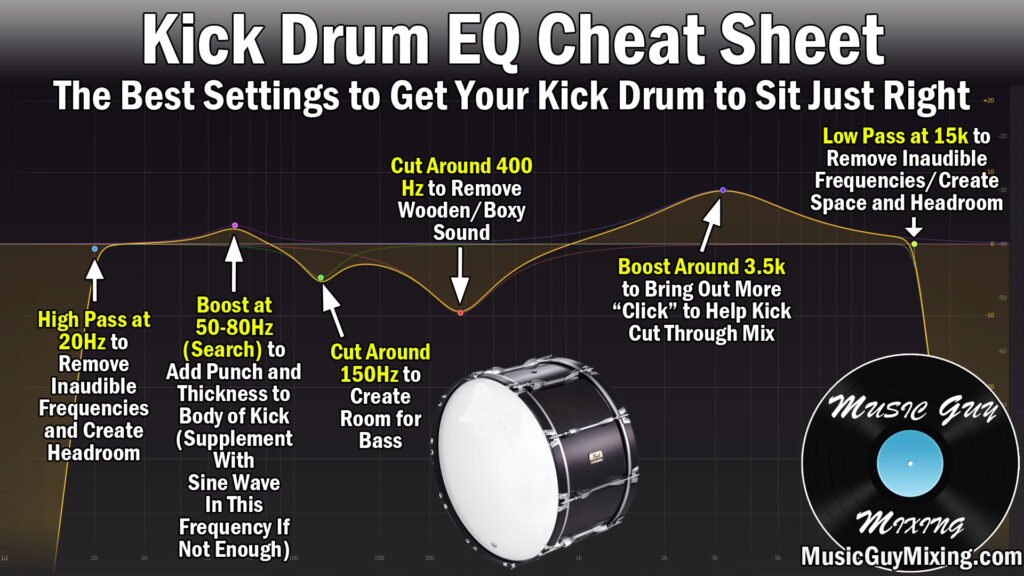
Above pictured is my favorite plugin, EQ or otherwise, the FabFilter Pro-Q 3. Let’s take a quick look at each recommended move to give a little context to account for why I recommend each move.
High Pass at 20Hz
This first move doesn’t have a bearing on the sound of the kick per se.
This is more about not being able to hear below 20Hz, so adding a high pass filter with a 24dB/oct or so EQ slope removes inaudible noise which yields more mixing headroom, allowing for a better sounding louder mix/master.
Boost at Body (50-80Hz)
As mentioned when referring to the Pultec Trick, the body of the kick is around 60Hz. The peak of your kick’s body may be slightly above or below that, so either solo or just look at the visual representation of your kick’s frequencies when it triggers in your EQ to see that peak which represents its fundamental frequency.
Giving this a small boost can help bring out more of the “meat” of the kick, helping it better establish the tempo and rhythm of your mix.
This is especially helpful in the case of a thinner kick which is more top heavy.
Cut Around 150Hz
Like I recommend making a sidechained EQ cut on your bass to create room for the kick in its body (see how to sidechain EQ bass to the kick), I likewise opt to create a complimentary cut on the kick for the bass.
Similar to the sidechain nature of the complimentary bass cut, you can sidechain this band to your bass so that it pulls that 150Hz pocket when the bass triggers, as well.
Cut Around 400Hz
The kick oftentimes has a kind of unflattering boxy sound which stacks around 400Hz which may be more or less prominent from recording to recording or sample to sample.
We can clean this up with a gentle, broad cut of 1dB or so to attenuate that effect on the tone on the kick. This helps to clean up the kick so that you don’t have to boost its top end for any kind of brightness.
Boost Around 3.5k
The one exception for generally boosting the higher frequencies on a kick is when you want to bring out more of the kick’s punch.
This is that percussive “click” sound of the beater hitting the drum itself which generally manifests around the 3.5k area.
A small boost here can help the kick assert itself in the mix, drawing the listener’s ear to the rest of the sound of the kick especially in a dense mix by way of that click. This makes the kick sound a bit cleaner and responsive, as well, especially in a busier mix as mentioned.
Low Pass Around 15k
A conservative spot to roll off the highest, largely inaudible top end of the kick via a low pass filter is around 15k.
You can easily low pass the kick here without worry of losing any part of its tone, but this creates space for the cymbals, vocal air, and creates a modicum of added headroom to the entire mix as a unit.
I mentioned high passing at 20Hz on the kick drum with your EQ. It’s important to high pass every other track in your mix, albeit at higher frequency points to remove unwanted noise and create more space for your kick to have complete dominion over the lowest end of your mix.
You can see where I recommend high passing every single instrument and vocal in your mix via my free EQ cheat sheet.
Also check out my complete guide on mixing a kick drum for a detailed, step by step guide to getting the anchor of your mix sounding its best.