While oftentimes we’re after vocal clarity through EQ, with some genres or more specifically songs we’re after adding or bringing out warmth in our vocals. This warm vocal EQ cheat sheet will cover the exact cuts and boosts to make to get your vocal sounding warmer.
Warm Vocal EQ
A quick reminder before we get into the warm vocal EQ settings – you can only do so much with an existing recorded vocal.
A warm sounding vocal begins in the recording stage, so make sure your vocalist is right up on their microphone, ideally within 6 inches, and they don’t move around during the recording as that’s when the vocal begins to thin and lose body and warmth.
Just as importantly, make sure you’ve got a microphone with a flat response through the low-mid to high-mid frequencies (see my best vocal mic overview).
Now let’s get into the cheat sheet; I’ll follow it up by talking about each move I recommend in greater depth:
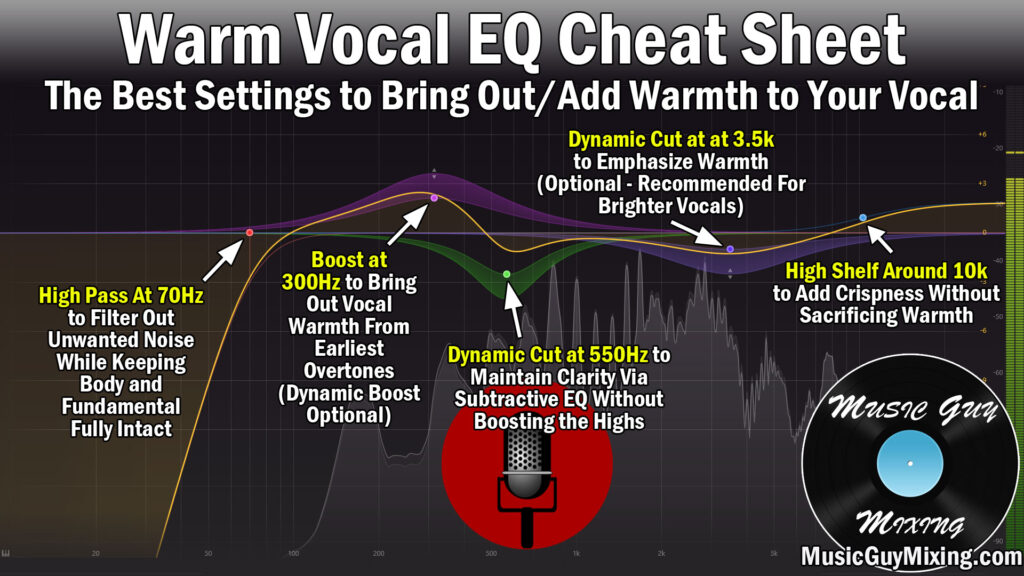
Note that some of the adjustments I recommend (cuts and boosts) are dynamic EQ bands, meaning they’ll cut or boost more or less depending on the level at that frequency range from beat to beat.
Check out my favorite EQ, FabFilter’s Pro-Q 3 via my FabFilter Pro-Q 3 review, or grab a nice free dynamic EQ option in the TDR-Nova.
Now let’s get into the recommended warm vocal EQ moves from low to high.
High Pass at 70Hz
This is more of a housekeeping move which I always recommend regardless of what kind of vocal EQ you’re looking to do.
High passing your vocal removes unwanted frequencies and noise without creating any palpable change to the sound of the vocal. This helps clean up your mix, not to mention create space for the instruments which need the low end, creating a better overall sounding mix.
The only question is where to high pass your vocal. In the case of male vocals, 70Hz with an 18dB/oct slope ensures you’re not losing anything in the body which is the tail end of the vocals warmth, at least on the higher end.
With female vocals, you should aim for roughly 100Hz, 18dB/oct slope high pass filter.
Admittedly, these are very conservative points; you can oftentimes get away with 100Hz and 130Hz for male and female vocals, respectively.
As always, audition your vocal with and without the filter in place. You shouldn’t hear any difference – if you do then simply dial it back (down) 10Hz or so.
Boost at 300Hz (Dynamic Optional)
When we talk the warm frequencies, we’re talking starting around 300Hz. Add a decent 2-3dB boost here to bring out more of the top of the body and low end of the warmth in that vocal EQ.
You’ll see I have a dynamic EQ boost set, meaning it boosts relative to what’s happening at 300Hz bar to bar, beat to beat.
A nice bonus is that this adds a very pleasant liveliness to the vocal. At most, it’s adding 3dB which works for my particular vocal in this part of this song, so adjust accordingly to get that fullness in those low-mids that you’re looking for.
Dynamic Cut at 550Hz
A clean vocal and a warm vocal are NOT mutually exclusive, and my recommended dynamic cut at 550Hz is proof of this. This is that area where you get a little mud either from reflections or purely from a somewhat unflattering frequency range on most vocals.
I don’t like a static cut when I’m cleaning this up. As such, this is the sole instance of an adjustment in warm vocal EQ I always recommend where I do specifically recommend a dynamic cut because certain notes will require a deeper cut than others.
I’m just looking to achieve 1-2dB at most, but by way of subtractive EQ this actually adds in some clarity without having to sacrifice any warmth from your vocal. It also adds clarity without having to boost in the more presence-leaning frequencies which can shift the emphasis away from the warmth.
(Optional) Cut at 3.5kHz (Dynamic)
The one optional move in this warm vocal EQ overview is a dynamic cut around those aforementioned presence-leaning frequencies at 3.5kHz.
This is vocal specific, meaning it varies from vocal to vocal. If you have an inherently brighter vocal either by virtue of the microphone, recording setup, or the vocalist themselves, you may want to pull the frequency profile away from this slightly with a dynamic cut right there between 3-4kHz.
Nothing much as we don’t want to dull the vocal for the sake of warmth, but 1-2dB at most can help steer it in the right direction overall.
High Shelf at 10kHz
I like a high shelf around 10-12kHz through the upper end of the vocal’s frequency range (a low pass filter at 20kHz is optional) as this doesn’t detract from the warmth we’ve established through the rest of our moves.
A small 1-2dB boost here via that high shelf is a great way to ensure that the transient punch of the vocal still comes through, perfectly balancing out the warmth with assertion in the mix.
It also brings out a bit of crispness, as well, which again doesn’t detract from the overall warmth of the rest of this warm vocal EQ cheat sheet.
Warm Vocal EQ Tips
- High pass your vocal between 70-100Hz and 100-130Hz for male and female vocals, respectively, to remove noise and clean up the vocal without cutting into the body.
- Boost around 300Hz for a 2-3dB gain addition to bring out more of the inherent warmth of your vocal. A dynamic cut helps to manage the precise gain boost from note to note.
- Add a dynamic cut at 550Hz to remove 1-2dB of vocal mud as necessary for some clarity without sacrificing warmth or boosting the more conventional “clarity frequencies”.
- For an especially bright vocal, tame that sound with a 1-2dB (dynamic) cut at 3.5kHz to shift the entire vocal to a warmer tone.
- Add a small 1-2dB high shelf from 10-12kHz to add some punch to the vocal without sacrificing warmth, keeping your vocal warm yet present throughout the mix against the instrumental.