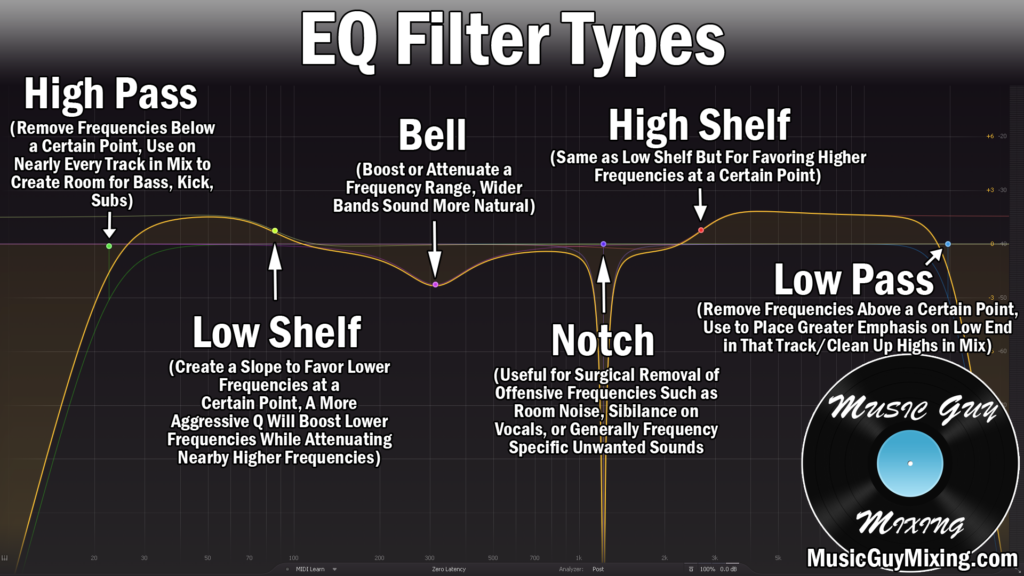
Backing vocals can serve a number of purposes in your mix. They can harmonize with the lead, fill in some gaps, or provide a kind of vocal bedrock to prop up the lead. Regardless, the approach when you EQ backing vocals differs from lead vocal EQ, and oftentimes we want to sacrifice a bit of the top and low ends of our backing vocals to create more space for the lead, not to mention contrast with it a bit which helps BOTH the lead and backing vocals stand out in your mix.
Let’s cover the best settings to dial in when you EQ backing vocals.
EQ Backing Vocals
Filtered down to its most simple level, a reliable set of adjustments to make when you EQ backing vocals are high and low pass filters at 300Hz and roughly 5.5kHz, respectively:

First, let’s address the high pass at 300Hz when you EQ backing vocals (with a gradual 12dB slope).
While I always recommend adding a high pass filter to virtually every track in your mix to clean up things and just as importantly create space for your mix’s low end, on lead vocals I typically recommend filtering out everything below 100Hz and 130Hz for male and female vocals, respectively.
And while the specific points will vary from vocal to vocal, this generally removes low end ambient noise and unwanted frequencies without cutting into the body of the voice.
When you EQ backing vocals, I recommend aiming higher to the aforementioned 300Hz range. This admittedly does cut into the body of the vocal and ultimately thins it out a bit, but this is a sacrifice which is well worth backing as it helps to create that aforementioned contrast from the lead, giving the lead sole dominion over the body range of the vocal.
This creates a little separation between the two, especially if you’ve got or are forced to have both vocals near each other (more on this in a moment).
Before we get to the high end point of EQing backing vocals, note that EQ isn’t the only way to create space with the lead and I’ve referenced this on and off here. Panning is just as important, so refer to this image taken from my guide on panning backing vocals for more information on not just getting them out of the way of the lead but giving them their own space as necessary:
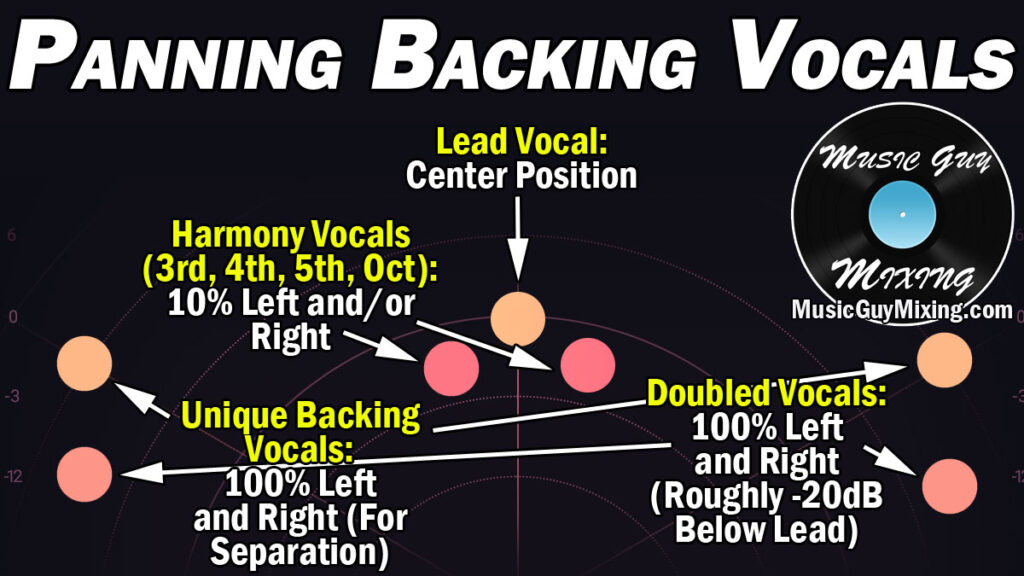
The above image gives you helpful snapshot of the panning positions to use for your backing vocals relative to your lead which should almost always be centered. This helps to keep the backing vocals out of the way and, combined with the EQ filters, makes both the lead and backing vocals blend better and hit harder.
Getting back to the subsequent EQ filter in working left to right, low to high, I like to roll off the high end of my backing vocals with a filter around 5.5kHz.
Like the low end of the backing vocals is sacrificed to some extent to make the lead hit harder, the top end sacrifices some of the “bite” to reserve the presence and punch of the vocal portion of the mix entirely for the lead vocal.
Try a relatively gradual, slow slope of 12dB to create a natural roll off, even referencing your mix in real-time while you do it at a stretch where both the backing and lead vocals are playing simultaneously.
Not only does this save the bite for the lead, it also subtly pushes the backing vocals a bit farther back due to the fact that higher frequencies cause the listener to perceive audio as being closer. Roll these off in that 5-6kHz region and it’s a reverb-free way to give your backing vocals a bit more depth while, once again, the contrast makes the lead feel more in front of the mix.
Of course and speaking of reverb or spacial based effects, EQ is only one piece of the pie. Refer to my complete guide on mixing background vocals for every tip for getting your background vocals sounding and sitting their absolute best in your next mix.