Saturation and distortion are two terms which commonly get used interchangeably in the world of audio production. This begs the question in regards to saturation vs distortion, are they the same thing and if not, how do they differ?
Saturation Vs Distortion
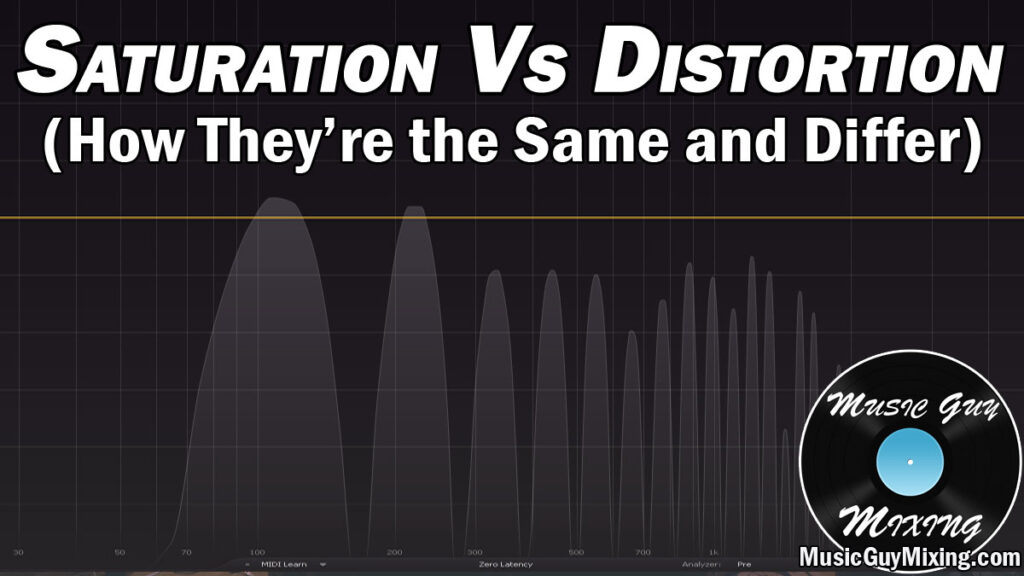
Saturation vs distortion are both closely related in that they’re both (in the world of mixing) used to alter sound and effectively create additional harmonic frequency and overtone information in your audio:

Strictly speaking, though, saturation vs distortion are different in HOW they alter sound. Furthermore, they each have a different application.
Let’s begin with saturation.
Saturation
I even admitted as much in my overview of what does saturation do, but saturation involves applying distortion to but also compressing the waveforms of your audio.
Here is a very simple before and after visualization of the waveform of a simple sine wave before and after saturation:
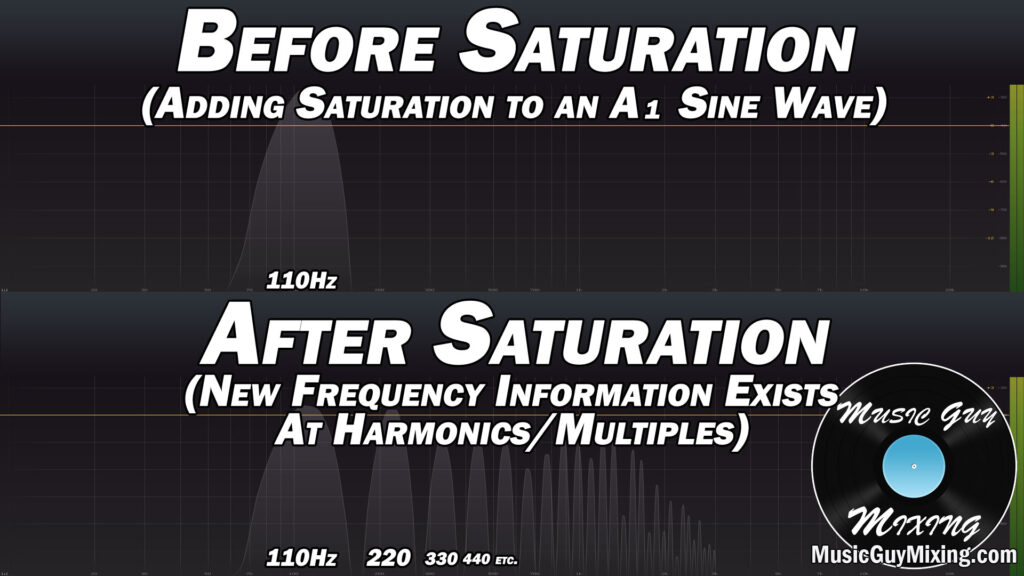
By definition, saturation occurs when an audio signal overloads an electrical component.
In the earliest days of audio production when everything was recorded to tape and processed with analog equipment, this would create a byproduct of a low noise and harmonic distortion which affected the audio and resulted in a less punchy, smoother, warmer sound.
In modern recording studios when everything is processed “in the box” or digitally, you achieve much cleaner and brighter recordings, but you lose byproduct warmth.
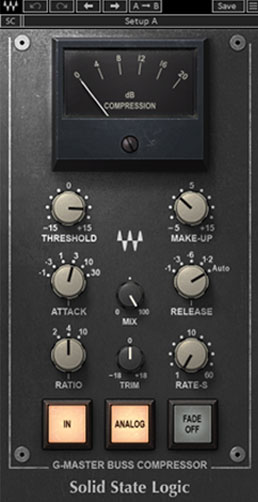
Because it was the norm for decades, audiophiles as well as fans of music from the 50’s, 60’s, 70’s, and into the 80’s and 90’s have grown an appreciation for that warmth. As such, you’ll get designers of plugins which attempt to chase that analog sound like Waves adding in the option to artificially recreate and impart a bit of that analog tape warmth onto recordings like is shown on their SSL G Master Bus Compressor:
There are also countless dedicated saturation plugins which can be used to artificially add a little controlled compressed distortion to balance out your tone as necessary, like one of my favorite go to plugins in Decapitator from Soundtoys:

I mention this frequently in my tutorials here, but I often like to work in a bit of saturation to smooth or fatten out a tone which is thin or top heavy.
While we can boost the mids via an EQ, it’s not ideal to boost something when the problem is it doesn’t inherently have enough of it.
Saturation artificially creates a greater frequency presence in the mids to warm it up when necessary, also giving it that classic analog sound.
Distortion
So if saturation involves distorting a waveform, what exactly is happening via distortion?
Distortion involves actually affecting and changing audio’s waveform. We’re driving a waveform’s peaks up to the point of clipping (see what is clipping).

When those peaks get driven up against that point of clipping, which for all intents and purposes is the “ceiling”, the peaks get flattened, resulting in the white noise harshness we associated with clipping. In a word, this is distortion.
The harder we amplify the waveforms amplitudes, the more of it gets flattened, resulting in an even harsher distorted noise, a greater distortion.
Distorted guitar has been a staple of the rock genre for decades, taking an otherwise clean guitar tone and distorting its waveforms to achieve that edgy, gritty, aggressive sound.
For what it’s worth, there are subsets of distortion within the context of guitar tones, like fuzz, overdrive, and even distortion itself, but that’s a discussion for another day.
Distortion’s only application in your mix is far from being limited to just guitar. We can apply the relative extreme effects of distortion whenever we want that exaggerated aesthetic effect whether it be on vocals, drums, the mix bus itself for a small stretch for a bit of dynamic change.
We can even use distortion to add audio transients to a kick or snare drum to help them crack and cut through the mix when they’re TOO rounded and not asserting themselves in the mix.
Saturation vs Distortion Summed Up
In summation, saturation vs distortion are two very similar elements cut from the same cloth and are oftentimes used interchangeably as terms (admittedly by me on occasion on this site).
Practically speaking and technical differences aside, in the world of mixing saturation is a more subtle effect and is most commonly used to warm up and place a greater emphasis on the mids of otherwise thin or top heavy audio, creating a better balance.
Conversely, distortion is used for a much more pronounced, palpable, and intentionally clipped effect to thicken, beef up, add some top end bite, or all of the above to the affected audio.
That’s the best way to describe it; so while you now have a better idea of the textbook differences, more importantly you understand each effect’s place in processing your audio to achieve different results.