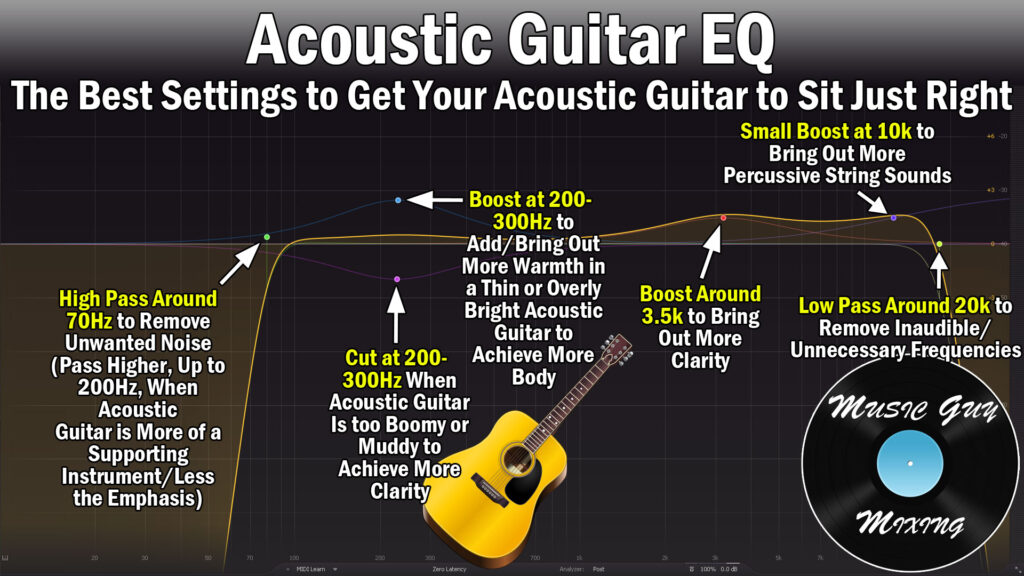
Acoustic guitar can play a variety roles in a mix. Oftentimes this is dictated by the genre as folk or singer/songwriter music will heavily feature the acoustic guitar and as such it will take up more real estate so to speak in the mix. Other times you might just be using an acoustic guitar as another layer in a busy mix, tucking it off to the side. All of this begs the question of where should you pan acoustic guitar in the mix for the best results, so let’s answer that question while covering all situations and contingencies.
Where to Pan Acoustic Guitar

First, it’s important to account for the number of tracks you’ve got representing a single performance on the acoustic guitar.
I referenced the role of genre in influencing where to pan acoustic guitar in opening. When the acoustic guitar is playing a sizable role in the mix, it can be ideal to double track acoustic guitar.
This refers to recording the same part with two unique takes. This allows you to pan the two acoustic guitar recordings wide, giving the acoustic a lot more size in the mix.
My audio panning guide for the entire mix reflects this as we can pan those two unique recordings on the far left and right sides of the mix:

This is my go-to method of how I pan acoustic guitar when the acoustic is especially important in the mix like in the aforementioned folk or singer/songwriter genres.
Note that you can also take a single performance which was recorded with two mics and spread them wide, as well, and depending on how those two tracks were recorded, this can produce a number of different sounds.
With the neck and bridge recording technique, you’ve got two microphones recording a single performance:

One microphone is pointed around the 12th fret, roughly where or just above where the neck meets the body. This captures a much brighter, string heavy sound.
The second microphone is pointed at the bridge at the base of the strings. This captures the darker, fuller tone of the body.
You can then pan them hard left and right against one another in the mix for a nice contrast of body on one end and top end punch on the other, giving the listener a stereo-like effect when they listen back.
This should work whether you recorded these as two mono tracks or a single full stereo track, but in the case of the latter should you want to separate them so you can process one or both tracks separately (possibly for different EQ corrections), refer to my quick guide on how to split stereo tracks.
I should also note as a reminder that whenever you record a single source (i.e. acoustic guitar) with two different microphones, this introduces the possibility of phase issues. This happens when the sound reaches one microphone slightly ahead of or behind the other so that the phases are out of sync. Refer to my guide on how to achieve in phase audio for a quick guide on that, as well.
If you want a more balanced tone between the two guitar tracks, try the XY recording technique the next time you record acoustic guitar as this provides a much more subtle contrast between the two and yields a fuller acoustic sound across the entire mix when you pan your two acoustic tracks (or single stereo track) hard left and right.

To give you even more fullness, I like the mid side mic technique which is more complicated and requires a special figure 8 polar pattern microphone but allows you to leave an acoustic track in the center as well as the sides.

Regardless of how you recorded your acoustic with one take or two unique takes and regardless of the microphone setup, the second option gives the acoustic more size and width in the mix.
There are other options, more hacks, for getting more size out of your acoustic with only a single mono track, like using chorus on acoustic guitar, but there’s no substitute for the real thing.
One last note on two unique recordings versus one recording with two or more microphones – two unique recordings have consistently unique pitch and timing, meaning they generally will sound naturally larger and wider in the mix. Still, when recorded properly, a single recording with two microphones can get you the sense of size that you want when panned wide, as well.
In the case of a mix where the acoustic is playing more of a supporting role, I like tucking it between 25-50% off center, typically against the piano or, in the absence of that, the hi-hat.
When this is the case, I’ll oftentimes high pass my acoustic guitar much more aggressively as I’m more interested in the transient punch and brightness of the strings themselves than I am the body and fundamental frequencies of the notes and chords.
As such I’ll high pass to cut out the fundamental region and most of the boxy frequencies as well (as demonstrated in my acoustic guitar frequency range chart):

I talked about this in my overview on EQing acoustic guitar, so refer to this for more information.
At that point, the acoustic becomes more of a percussive instrument almost as we’re focusing on the sound of pick or fingers on strings in addition to some of that mid-range character.
This works very well in say a pop mix where that acoustic guitar is just blending in with the rest of the tapestry of the instrumental and serving to prop up that vocal. Again, I like to pan acoustic guitar about 25-50% off center in this case opposite of the hi-hat, setting the level to taste whether that means a bit more buried in that instrumental or not.
How to Pan Acoustic Guitar Tips
- The role of the acoustic guitar in the mix is chief in determining how and where to pan it.
- In mixes where it’s more of an accent piece, I like to high pass it to around 500Hz or so with a 12dB/oct slope and pan it 25-50% off center, opposite of the hi-hat or piano (when applicable).
- In mixes where the acoustic is doing more of the heavy lifting, I like to double track or at least use two or more microphones and pan them hard left and right.
- When panned hard left and right, two unique recordings can help create a natural width, size, and fullness you can’t with a single recording (with two microphones also panned hard left and right).
- Depending on the recording technique with multiple microphones, a single recording can yield different results. This includes the neck and bridge technique for body on one side and string punch on the other, the XY technique for getting the most consistent sound between the two mics, or the mid side recording technique which requires a figure 8 microphone but can yield the fullest sound with one recording as this includes a center panned track in addition to the stereo sides.