808s are a combination of both bass and percussion and help drive a mix forward rhythmically and otherwise. Because they share a lot of traits with kick and bass, it’s a similar approach on how to mix 808s to get them sounding their best and sitting just right.
Let’s cover how to mix 808s.
How to Mix 808

As I covered in my overview of what is an 808, we’re typically referring to the bass drum sound either from or influenced by the Roland TR-808 drum machine of the early 80’s.

Initially considered a flop, the sounds of the drum machine gained a cult popularity and eventually went on to be featured in countless hit hip hop and electronic music tracks.
This is particularly true of the “808 itself”, or the bass drum sound which is essentially a bass drum with a lot of delay and sustain on it.
In genres which especially feature and highlight the bass drum like the aforementioned hip hop and electronic music, a common technique is to layer the 808 on top of another bass/kick drum in a mix. This helps to better emphasize the combination of the low end anchor of your mix in the kick.
Sidechain 808 to the Kick Drum
With layering in mind and considering these two instruments share virtually the exact same frequencies, I like to duck the front of the 808 out of the way of the kick drum.
This gives the complete dominion over the transient punch of the kick and the front of its body “thump” to the kick drum while giving us the 808’s subsequent sustain for the remainder of the sound, not to mention that added back-end sustain.
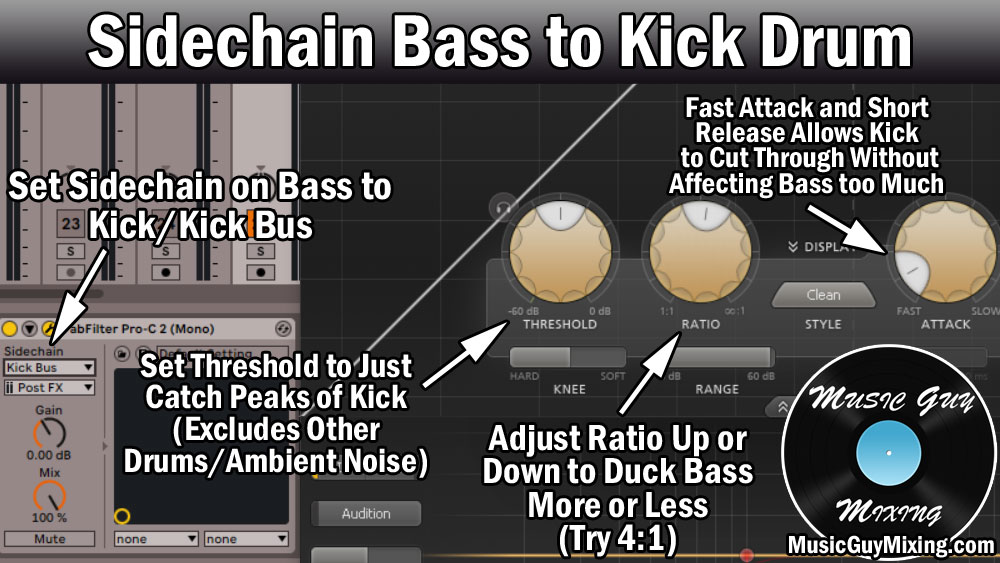
To do this, you can use sidechain compression or sidechain EQ to just pull the overall level or targeted frequencies of the 808 down, respectively, when that kick triggers.
I talked about how to sidechain bass to a kick drum, it’s the exact same process – just drop the compressor on your 808 instead of your bass and set it up like so:
If you’re using sidechain EQ, you’d create dynamic EQ cuts at the core body frequency of your kick (usually around 65Hz) and at the transient punch of the kick (usually around 3.5kHz) on your 808.
With this setup, the 808 gets its level pulled down when the kick triggers either uniformly across its frequencies with sidechain compression or just in those two targeted areas with sidechain EQ.
This allows the kick drum to fully assert itself first when it triggers, drawing the listener’s ear to it and creating that little bit of separation which helps to keep things clean.
I alluded to this with the bass and have talked about this before in covering low end mixing tips as a way of keeping the low end clean by getting two instruments which share a similar frequency range and panning location out of the way of each other.
To that end, I still recommend that you sidechain the bass out of the way of the kick as described above to keep everything clean and visible in that all important sub-200Hz frequency area.
I know some people will alternatively or additionally delay their 808 by 10-50ms or tightly crossfade it from the tail of the kick to achieve that separation and avoid any phase issues, so that’s an option as well.
Pitch 808 to Kick Drum (Or Vice Versa)
For a little extra symmetry, you can pitch your 808 to your kick drum or vice versa.
I’ve talked about this in matching your kick to the key of your song for a little extra, subtle cohesion.
In Ableton Live, you can simply select the clip(s) you want to adjust the pitch for, setting the warp mode to “Pro”, then adjusting the pitch dial in the bottom right of the clip:

This is a very easy way to get that added cohesion between your 808 and your kick, not to mention potentially the mix as a whole.
It’s even more important to duck the front end of the 808 out of the way of the kick as described above when you’re matching the pitch as they’ll share the exact same fundamental frequency in that case.
Parallel Compress Your 808
I absolutely love crushing my 808 by way of some parallel compression.
Create an Aux/Return track, drop your compressor of choice on it, then dial in these parallel compression settings:

Now simply turn up the respective send dial for that track on your 808 until you get the amount that you want. As a general rule of thumb that you can’t go wrong with, turn it up until you can hear the parallel compressed instance of the 808, then turn it down 1-2dB.
This thickens out the body of the 808 while giving you that extra oomph on the back-end, that little extra presence in the mix. With the instant attack, it’s also clamping down on the initial transient punch, so there’s no issue with competing with the kick, even if you didn’t use any sidechain processing.
Duplicate and Emphasize the Higher End
Another way I teach on how to mix an 808 is to duplicate it and scoop out the low end on that duplicate with a high pass filter.
Set the filter point to around 500-600Hz to remove everything below that. This removes the fundamental and first overtones, really everything in the low and low-mid frequencies.
Now that duplicate track just has the higher end which I find sounds nice with a little saturation for some palpable sizzle (you can’t go wrong with Decapitator with full gain, maybe even “Punish” engaged).
I also like to drop a stereo imager on this duplicate and push it exclusively to the sides so it’s completely getting out of the way of the original, unfiltered 808.
You can likewise work in some parallel compression on this either on the side or as an insert as we’re not concerned with preserving the natural sound of the 808. This is for a bit of ear candy and accentuating the sound of this track without compromising our original 808.
All of this together helps the 808 sit better across the mix while giving it a unique flavor, as well.
Perhaps most importantly of all is to make effective use of reference tracks for sculpting the sound of your 808, get ideas on how to implement it in your mix, and just as importantly where to set its level alongside your kick.