EQing acoustic guitar is all about cutting what’s not contributing or enhancing your acoustic guitar sound and leaving what is by way of subtractive EQ with the odd boost. Let’s talk the best settings for EQing acoustic guitar which I begin with every single time I have acoustic guitar in a mix, regardless of its role.
EQing Acoustic Guitar
Let’s go left to right or better said low to high in terms of the adjustments which I recommend for EQing acoustic guitar to get the best overall sound from your recorded acoustic.
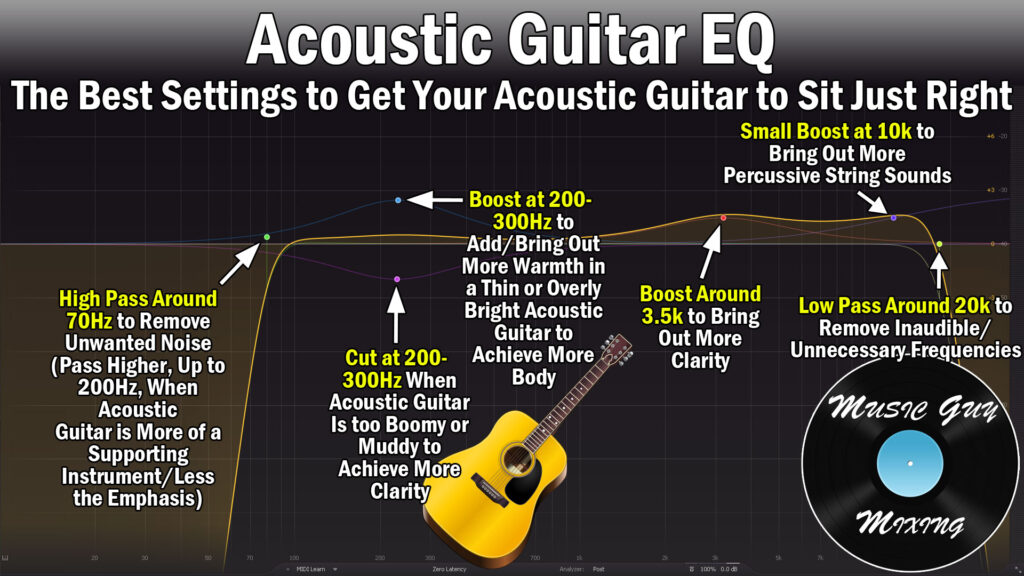
High Pass Around 70Hz
First, you want to high pass your acoustic guitar to remove non-musical sounds, not to mention room noise or recording noise which isn’t adding to the sound of your acoustic.
As I covered in my acoustic guitar frequency range overview, the acoustic guitar’s fundamental frequency of the low E string in standard tuning is 82Hz:

As such, 70Hz is a safe place to set our high pass filter when EQing acoustic guitar without worrying about cutting into the fundamental body of the lowest note on the acoustic guitar.
Use a 12dB/oct or 18dB/oct slope to keep a natural to slightly tighter filter which you shouldn’t hear a musical difference with it toggled on or off, and move on to the next adjustment.
Cut or Boost at 200-300Hz to Adjust Body
200-300Hz is dead center in the fundamental range of the acoustic guitar. You could even approach it with an adjustment from roughly 100Hz to a little over 330Hz to encompass that full range from low E to high E strings when played open.
Adjusting this is an adjustment to the body and warmth of the acoustic guitar, and I always approach whether I cut or boost here from the perspective of what is the acoustic guitar lacking.
If the recorded acoustic guitar is lacking body and warmth and is thin and top-heavy from a higher frequency perspective by virtue of the recording process or the guitar itself, a small boost here is in order to add a little thickness, fullness or warmth.
Conversely, if I have a boomy or dull sound, I might opt for a small cut in the 200-300Hz or so range.
The acoustic guitar’s role in the mix also factors into the adjustment I make, even when this range isn’t a problem one way or the other.
In a genre or a mix where the acoustic guitar is playing a large role, I’ll fully preserve the low-end and adhere to the EQing acoustic guitar cheat sheet as shown above.
On the other hand, I’ve used acoustic guitar as an accent to a mix many times and from that perspective I’m willing to high pass much higher, going well into the 300-500hz or higher range.
In this case, I’m mostly using the acoustic guitar for the sound of the strings, both in terms of some thinner overtones from those filtered out fundamental frequencies as well as the percussive sound of the strings.
This actually helps the acoustic slot into and contribute to the tapestry of sounds in pop and rock (or any genre) mixes, not to mention creates more low end space which is always a good thing in the mix.
Boost Around 3.5kHz for Clarity
3.5kHz adds a little clarity and bite to the acoustic.
Like the attenuation we could’ve made in the fundamental range to shift the focus of a dull, boomy acoustic, we can help shift our acoustic to a brighter sound by way of EQing acoustic guitar with a boost around 3.5kHz.
You can even use this in place of cutting that fundamental 100-300Hz range to create some subtle clarity without sacrificing body.
Small Boost at 10kHz for Transient Punch
The punchy, percussive sound of the strings themselves exists around 10kHz.
Regardless of how you’re using your acoustic guitar in your mix, a small high shelf starting around 10kHz adds some transient assertion to the acoustic to draw the listener’s ear to it even in a dense mix.
10kHz is also one of those ranges where we don’t have to worry about going overly bright or harsh as this range doesn’t grate even when overly boosting anywhere like it does at half that. In other words, in addition to creating some nice punch, this is a high reward, low risk boost which usually works when EQing acoustic guitar.
Low Pass Around 20kHz
If you want to low pass, you can conservatively get away without worrying about detracting from the top of the bite of the strings with a low pass filter at 20kHz, even a gentle 6dB/oct slope. This creates room for the top ends of other instruments and tracks in your mix like the cymbals while subtly contributing to the mix’s headroom.
EQing Acoustic Guitar Tips
- The fundamental frequency of the low open E string exists at 82Hz, so high passing at 70Hz with a 12 or 18dB/oct slope is safe for removing noise, cleaning up your acoustic, and creating low end mix space.
- High passing as high as 500Hz or so can be effective when the acoustic is playing a more supplementary role in the mix, particularly in denser mixes as the focus shifts to the thinner and higher overtones and sounds of the strings themselves.
- The fundamental frequency range of the open strings in general spans from just below 100Hz to just above 300Hz.
- Cutting in this range by 1-2dB helps to thin out a boomy, dull, bottom-heavy acoustic and create some clarity via subtractive EQ.
- Boosting in this range by 1-2dB helps to add body and warmth to a top-heavy, thin acoustic.
- A small 1-2dB boost around 3-5kHz helps to add some brightness to your acoustic, allowing you to leave the 100-300Hz region untouched when you want clarity without sacrificing body.
- A high shelf around 10kHz helps the percussive, transient punch of the strings themselves assert themselves to keep the acoustic present and visible in the mix to the listener.
- 20kHz with a gentle and wide slope like 6dB/oct is a conservative low pass filter point to create a little headroom without sacrificing clarity or transient punch.