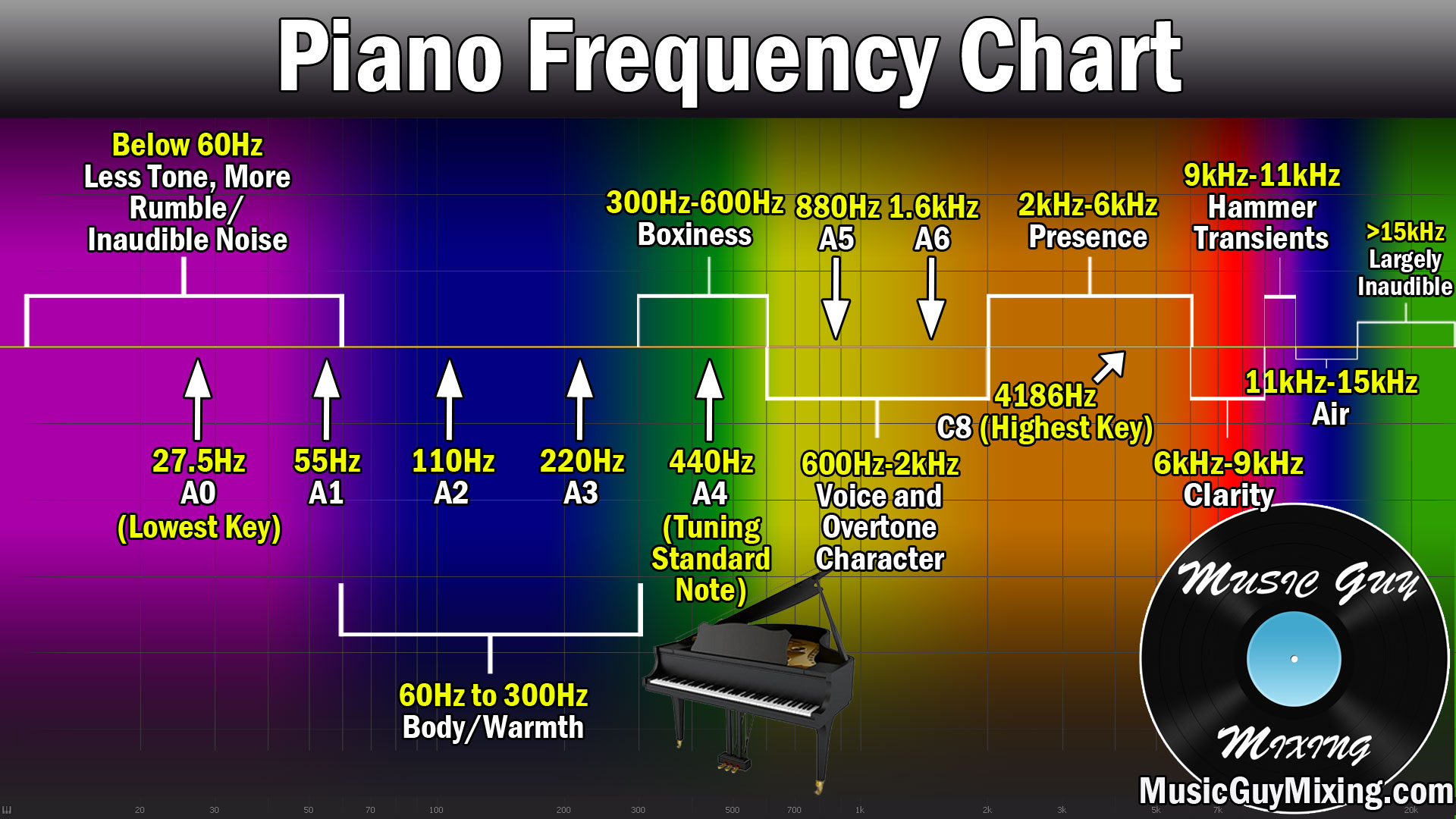
The notes of a piano range from 27.5Hz all the way up to just over 4k, but there’s a lot of nuance in that fact. The practical fundamental range of the piano is more contained, and the overtones and higher frequencies all boast their own unique characteristics. Understanding this can help you better EQ piano, so let’s take a look at this piano frequency chart to better understand the important frequencies of our piano.
Piano Frequency Chart
You can download this chart if you like with the link below, but let’s break down what’s happening in each section of this piano frequency chart.

Below 60Hz (Less Tone)
Describing the low end of the piano is interesting, because technically the lowest key on a standard 88 key piano is 27.5Hz. Practically speaking, very few performances will actually make use of this or any notes roughly in this octave.
Beyond that, you’ll find it’s actually the overtones of this lowest octave on the piano which really come through, and this begins at 55Hz which is where the first octave up on the piano in that A1 note exists.
This is why you can generally get away with high passing your piano around 60Hz if not higher, though this admittedly depends on the performance as well as the role the piano is playing in your mix and song.
If the piano is the focal instrument as in the case of a contemporary piano and vocal style ballad, you’re going to filter more conservatively and less aggressively on that low end to ensure you preserve the full audible range of the piano.
Otherwise, 60Hz can work well as a starting position, depending on the settings for your high pass filter.
60Hz-300Hz (Piano Body and Warmth)
Somewhat regardless of the notes played, the body of the piano lies primarily in that 60-300Hz pocket, though this can extend higher. I use this as the cutoff point on the higher end simply to draw attention to the next group, so suffice to say you should handle this range and beyond with close attention whenever you make adjustments.
This is where the fundamental frequencies for the bass notes exist, meaning these are the prevailing frequencies the bass notes will resonate loudest at.
From the piano frequency chart, you can see that over two full octaves are encompassed between 55Hz and 300Hz, from A1 to A3 and beyond.
In other words, this is the anchor range of your piano.
You’ll find a small boost here can bring more weight to your piano and give it some desirable warmth, depending on the recording.
Wider boosts are preferable as they sound more natural, and again the degree of the boost would be approached differently depending on the piano’s role in the song. I might not even touch the body of the piano’s range if the piano is more of a supporting piece.
300Hz-600Hz (Boxiness, Fundamentals, and Overtones)
From the piano frequency chart, I labeled this as the frequency range which lends an (undesirable) boxy quality to your piano.
As I just alluded to, this range is much more complicated than that, as some of the top end of the body and bass notes.
We also begin to get into some of the first notable overtones, or higher frequency octaves of the fundamentals from the last group in those purely bass notes.
Still, in the context of an entire performance, I find more often than not that a dynamic EQ cut to attenuate or otherwise pull out 1dB or so can go a long way in cleaning up and ultimately enhancing the tone of the piano in my mix.
This is one of the many moves I recommend in my aforementioned piano EQ guide:
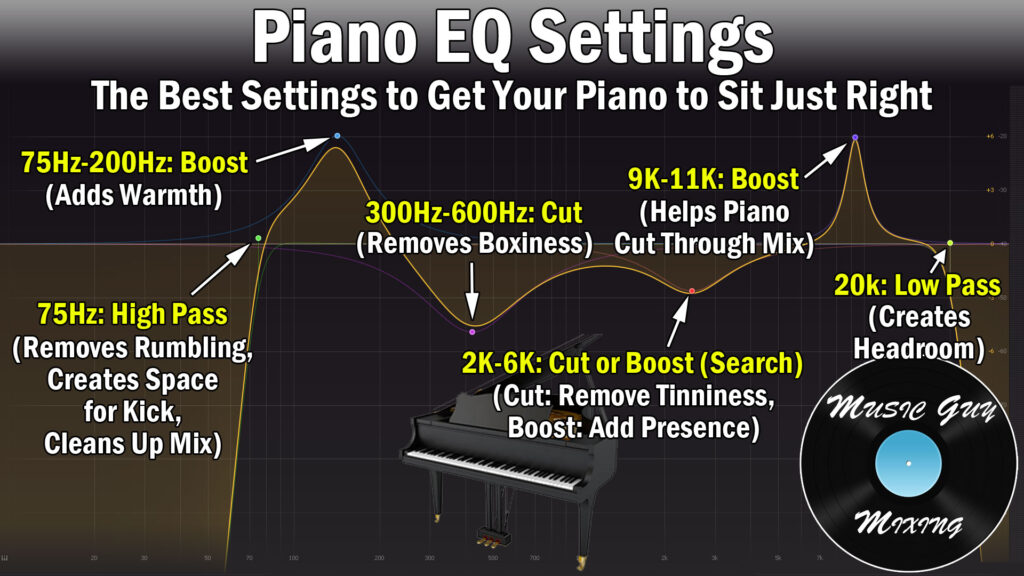
This small (dynamic) cut actually enhances the top end without sacrificing the body beneath it by way of subtractive EQ.
Again, I’m not cutting much, just a dB or so at most, but it really depends on the performance, recording/environment, reflections which can build up here, etc.
600Hz-2000Hz (Voice and Overtone Character)
More overtones stack up as we proceed higher up the piano frequency chart, not to mention we’re getting the fundamentals of the higher notes in the performance.
As such, there’s a lot of the voice and character of the piano coming through in the 600-2000Hz range.
I generally like to keep this range flat as you generally don’t want to detract from the voice here, and a boost can end up sounding unnatural very quickly.
2k-6k (Presence)
The 2k-6k range can be cut or boosted (or untouched) as the situation dictates.
As you can see from the EQ guide, cutting can attenuate the unwanted “tinniness” you can get with some recordings.
Conversely, boosting can add some presence to the piano to help it hit harder and sharper. Too much of a boost risks adding a unpleasant (not to mention unnatural) harshness to the piano.
Also notable in this range is that the fundamental frequency of the highest note on a standard 88 key piano (C8) exists at 4186Hz.
6k-9k (Clarity)
Our ears aren’t as sensitive in the 6-9k region as they are in say 3-4k.
As is often the case in adjusting the frequencies of our instruments, we can get away with a boost in the 6-9k region for some transients or in this case clarity without worrying about an unnatural or even grating tone from the piano.
We’re beginning to approach the transients on the higher end, however, so keep that in mind.
9k-11k (Transients)
Transients in audio terms refers to the initial high frequency percussive sound we perceive from a lot of sounds or, for our purposes, instruments.
In the case of piano, the percussive sound derives from the little percussive effect of hammers hitting strings when we press down on a key to make the note resonate.
That “biting” kind of click associated with every time a hammer hits a string immediately draws our attention to the rest of the note. In other words, the transient of the piano helps it cut through a mix.
This is why if your piano isn’t adequately asserting itself in the mix, it may benefit from a small boost in the 9-11k region.
If your piano isn’t feeling visible enough even with the boost, refer to my guide on adding or preserving audio transients as there could be other elements at play which could be mitigating their effect like compression.
11k-15k (Air)
Like the voice, the piano has an airy quality to it on the top end which can be brought out with a small boost in the 11-15k range to give it some crispness.
Admittedly your listener might “feel” rather than hear this, but the effect is still received. A small high shelf might work best in this case.
Over 15k (Largely Inaudible)
There are some overtones ringing over 15k, more prominently on notes which are on the higher end of the piano, but it’s barely audible as the piano quickly dies off here, at least to our ears.
With that in mind, some like to low pass their piano around here.
Hopefully this piano frequency chart helped to convey not only the frequencies of a lot of the notable notes on the piano, but more practically speaking the tone and voice you’re hearing from the piano at each range.
After you’ve gotten your piano’s frequency straight, check out my guide on piano compression.