
In the context of guitar tones, there are a number of different subsets of crunchy gain and terms which get used interchangeably at times, namely fuzz vs overdrive vs distortion.
Truthfully each term differs both in the sonic tones themselves as well as what goes into creating them, so let’s differentiate between fuzz vs overdrive vs distortion.
Fuzz Vs Overdrive Vs Distortion
Let’s go in reverse order here, beginning with distortion.
Distortion
As I recently mentioned in my overview on saturation vs distortion, distortion comes from the concept of affecting a waveforms shape. By introducing more volume, more gain to a sound, you push the peaks of a waveform beyond the point of clipping:

When the peaks of the waveform are driven past the point of clipping, you begin to get that crackling white noise that we associate with clipping.
The more aggressively you drive those peaks, the crunchier and sharper an otherwise clean tone gets.
In the context of guitar tones, distortion gives the tone energy, thickness, and especially punch. The latter comes from the fact that the white noise we associate with clipping is typically high frequency and thus precedes the rest of the tone.
This can help a guitar tone cut through a mix, whether it be live or recorded.
Incidentally, I’ve talked in the past about how to add audio transients to instruments in the mix which are getting lost and aren’t asserting themselves enough.
One of the tricks to artificially adding that transient “punch” to an instrument/track which doesn’t inherently have it is to blend in a little white at the front of that track’s tone to draw the listener’s ear to it whenever it triggers in the mix.
In getting back to the context of guitar tones, typically when we think of guitar tones, distortion is associated with aggressively driving a tone’s waveforms well beyond the point of clipping to get a much crunchier and lively tone.
Overdrive
While the connotation can vary slightly, distortion as a tone is typically much more dramatic than overdrive (which, strictly speaking, is a form of distortion, albeit a lighter one)
This is because we’re more dramatically driving and clipping the tone with distortion versus overdrive.
Overdrive, on the other hand, involves artificially driving a tone beyond the point of clipping (overdrive), albeit much more conservatively.
By soft clipping a guitar tone in this way, you’re thickening it out and warming up those mids without drawing as much attention or contributing as much to the high frequencies.
This is the basis of overdrive – it’s a more measured approach to distorting and pushing the waveforms of your tone.
With this more conservative approach, you can impart a bit of low-mid and mid-range frequency warmth to thicken up a tone which is exactly what you want in some contexts and genres.
Outside of jazz which typically keeps the tone on the cleaner side, virtually any other genre can make use of a bit of overdrive to help thicken up the guitar tone in the mix.
That said and to bring it back to context and connotations, I have to acknowledge the term overdrive is still predominantly associated with rock music between the settings on crunchier amps and pedals.
Still, it depends on how aggressively you drive the tone, and on the more conservative end, musicians of virtually any genre can benefit from a more measured amount of overdrive in their tone.
Fuzz
Lastly, fuzz is a type of distortion which emphasizes the harmonics, overtones, and ultimately the high-mid frequencies almost more than the fundamental frequencies of a tone:

This makes a fuzzy distorted guitar tone pair nicely with bass. In my distorted guitar EQ cheat sheet, I like to high pass at 100Hz if not higher to make room for the bass and get them to work together.
The low end of the guitar isn’t as pronounced with fuzz; it’s more about the thick, rich, and obviously dramatically crunchy mids and high-mid frequencies.
That high passing is virtually already done for you depending on your on board amp EQ settings
When I think of fuzz, I think the signature distorted tone of Weezer (with the timestamp):
You hear a lot of fuzz in that garage band sound like Weezer was going for on those early records.
You also hear it layered in a lot of shoegaze rock to form a thick, crunchy, and yeah, fuzzy wall of sound to lay the vocals over.
This is heard in a song like Bloody Valentine’s “Sometimes”:
Fuzz doesn’t stand out or cut through a mix like other forms of higher gain distortion and is more subdued in that transient rich 6k range, but like in the couple of examples, you can hear how it makes a nice backdrop for everything else you layer on top of it.
A popular pedal for achieving this sculpted tone is the Electro-Harmonix Big Muff Pi fuzz pedal:
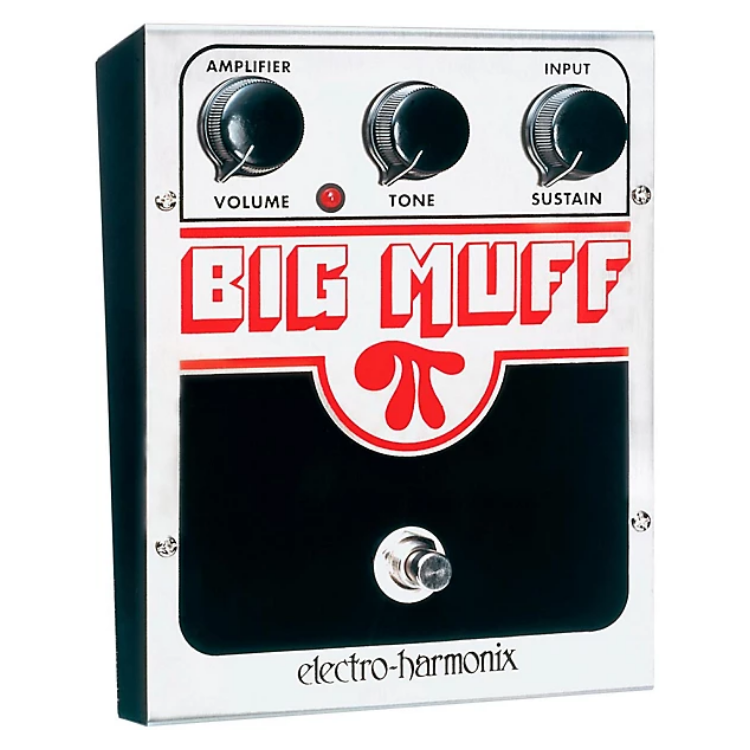
You’ll find the “Tone” controller is the real driver of just that. In place of an EQ, the higher you turn this, the more the emphasis transitions from the mids to the upper-mid frequencies to where you can start to get it to poke through a bit more, depending on your need.
In summation, admittedly there’s a lot of wiggle room with the terms of fuzz vs overdrive vs distortion depending on the context. Generally speaking they all refer to different flavors and degrees of distortion, meaning clipping the tone.
Each variety has its own place and role as a tone in the context of a full band for a live performance or in your mix as mentioned, so you should have a better idea of how they each differ now.