The tom drums cover a lot of frequency range in your mix and help to create a dynamic sound in the performance whether it’s a fill or a tom heavy part itself. Getting your floor and rack toms to sound their best begins with effectively carving out what isn’t working and propping up what is, so use this step by step guide on how to EQ tom drums to get your toms sounding perfect.
How to EQ Tom Drums
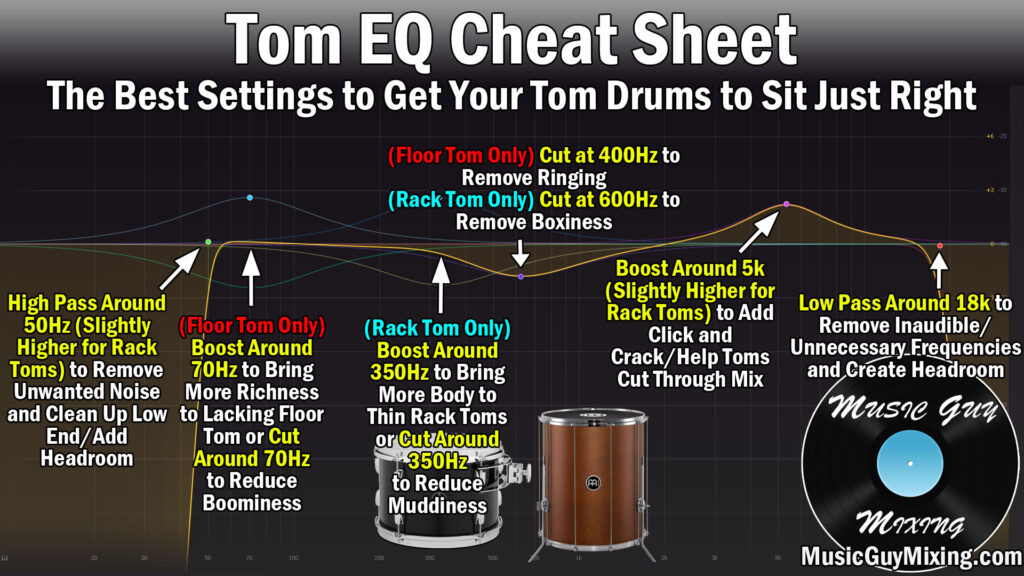
First, let’s take a look at a snapshot on how to EQ tom drums, frequency by frequency:
Now let’s go through each step as always with an EQ guide to better explain why I recommend what I do at each step in this EQ tom drums guide.
High Pass Around 50-80Hz (Depending on Tom)
The floor tom and kick share a lot of the same fundamental frequency, though the floor is a bit higher. With that in mind, we can high pass around 50Hz on the floor tom. The rack toms you’ll typically want to aim a bit higher, around 80Hz. This is admittedly a conservatively cutoff point, but this removes kick bleed and create space for the kick on your tom tracks.
This is the basic idea of high passing your toms, removing bleed and noise which isn’t inherent to or contributing to the toms themselves. This also creates mixing headroom which allows you to achieve a better sounding louder mix.
Boost/Cut at 70Hz for Floor Tom
In focusing on the floor tom specifically, you can bring more richness to the fundamental body of the floor tom by boosting at 70Hz.
Alternatively, depending on how the floor tom was recorded or is tuned up, you may get an abundance of that boomy at which point you may want to apply a small 1-2dB cut to the floor to attenuate and otherwise smooth this out.
Boost/Cut at 350Hz for Rack Tom
The fundamental on your racks will vary slightly depending on size, but you typically want to first target around 350Hz.
Here, you can apply a small boost to bring out more of the body as you did with the floor tom.
Alternatively, you might want a small cut to reduce some of the muddiness which can help clean up the tone and stop you from needing to boost higher up.
Cut at 400Hz on Floor Tom
Getting back to the floor tom, the ringing that is commonly associated with a floor tom which is improperly tuned or due to room reflections can be treated at 400Hz.
Apply a small cut or dynamic cut band around 400Hz to attenuate that annoying ringing to a more acceptable, less noticeable level. Don’t cut too much here or you’ll hollow out the sound; the goal should just be to smooth it out to a passable level if it’s especially apparent pre-EQ tom drums treatment.
Cut at 600Hz on Rack Tom
You can remove some of the boxiness on the rack toms by cutting in the 600Hz range. Again, this will vary depending on the size of the tom, but this is typically where a lot of those unflattering frequencies build up.
Remember to make this adjustment in the full context of the mix so that you’re not EQing the rack toms (or any toms or drums) in a vacuum to get the most realistic picture.
Boost Around 5kHz-7kHz (Depending on Tom)
Whenever I get questions relating to how to get the toms to sit better in the mix, it’s typically an issue of transient punch or a lack thereof.
The “punch” is the high frequency initial percussive sound which precedes the actual tone of the tom which you get from the sound of stick hitting surface.
Just like with the rest of the sound profile, the exact frequency you need to target will vary with floor versus rack toms.
With floor toms you typically want to aim for around 5kHz to boost 1-2dB to bring out more of that click sound.
Alternatively, with rack toms you typically want to aim for around 7kHz to boost around 1-2dB to bring out more of that crack sound.
The effect of these boosts is it will help draw the listener’s ear to that tom when it sounds in the mix without your having to boost its level when it’s otherwise set properly.
Low Pass at 18kHz
Lastly, low pass your toms at 18kHz. You can go lower on the floor tom and honestly with the racks, as well, but this is a conservative estimate which creates a bit more headroom in the mix and gets everything to sit properly.
All summed up, these EQ tom drums moves should have your toms sitting better in the mix with a better tone alongside the rest of the drums and mix overall.