
Reverb and delay are both spacial based effects to give your audio a sense of width and depth which isn’t inherent to the audio itself. This is useful when recording DI or an otherwise underwhelming acoustic space to give your audio more size. Applying these effects across your entire or the majority of your mix can help give the many tracks which make up your mix a sense of cohesion. One of the most common questions I get as it relates to using both effects is which to use first, reverb after delay or the other way around?
Let’s talk using reverb after delay vs using delay after reverb and establish which works and sounds best in your mix.
Reverb After Delay
While there are exceptions, as a general rule you want reverb after delay.
The reasoning for reverb AFTER delay is that reverb is a lot more complex and colored than a comparatively simple delay. You’re getting the sounds of the room with reverb as compared to the relatively clean delay.
As such and outside of rare exceptions, I like to have complete control over my reverb which you can only do if reverb is last in the chain.
Delay after the reverb understandably adds delay (duh) and size to your reverb, making those colored reflections larger which can quickly begin to muddy up and suffocate your mix.
But with putting your delay before your reverb, you can takes those clean reflections and adjust your reverb to begin to color and add size to them to find the best fit and sound for what you’re applying it to.
You can use this to create a luscious, dreamy quality to your delayed signal, giving your audio another level of textured space.
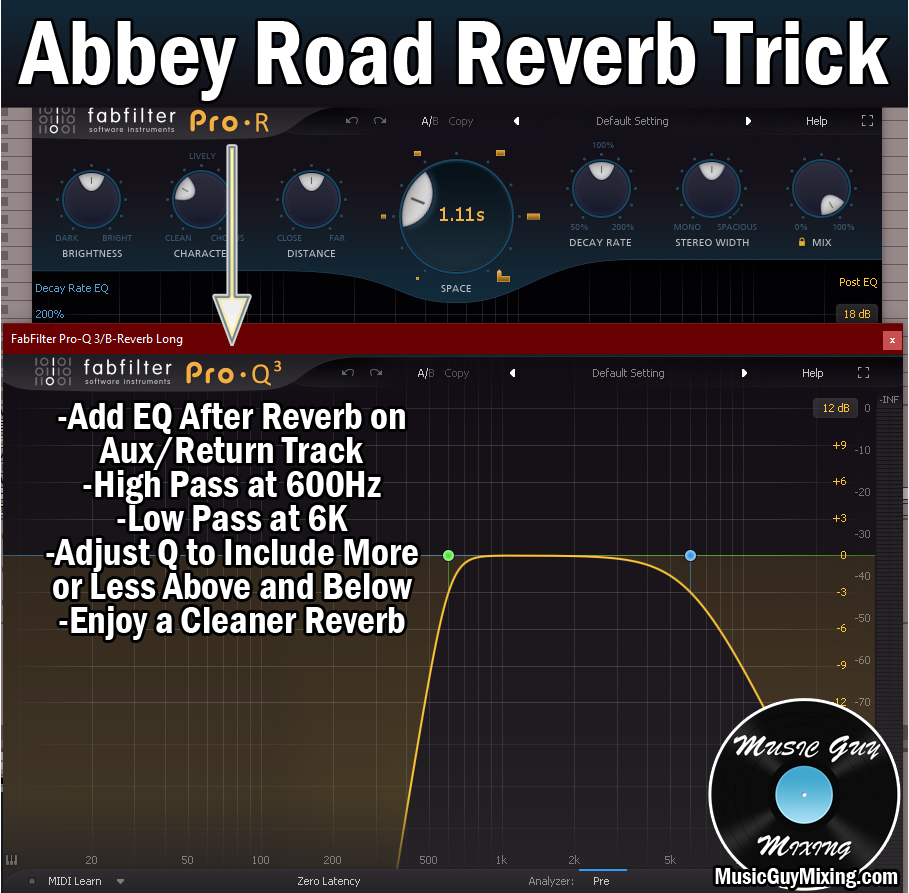
Still, it’s a good idea to EQ your reverb regardless of how you’re using it.
I know I preach the Abbey Road reverb trick all the time, but high passing your reverb should be a must to keep the low end of a reverb from dulling the low end and consequently clogging up your mix:
Delay After Reverb
I mentioned earlier that there are exceptions – the main exception to the reverb after delay rule is when you’ve got a short reverb and a longer delay.
In the case of replicating or otherwise emulating a smaller room with your reverb, chiefly meaning you’re using a very short decay time (and brighter character settings), you might want to follow that with a long-tailed delay.
I’ve gotten good results on individual tracks pairing small reverbs with long delays, mostly in cases of vocal throws or short and isolated one-off instances to get some interesting ear candy aesthetic results.
While using reverb and delay as serial effects either on the track you’re processing or on their own Aux/Return track is self-explanatory as to which comes first, another way to use these effects together is by sending an Aux/Return track with one effect into the other.
Sending your delay into your reverb or vice versa is an effective way to achieve a similar result but on a more macro level and is a great way to add a bit of color and size to your delay or tail to your reverb.
Just remember that whichever effect you’re sending into the other is actually coming AFTER that effect. So if you send your reverb into your delay, that’s similar to following your delay with the reverb if you were processing the two serially.
Less is generally more when you’re sending an entire Aux/Return track into another as you might just want a taste of that one effect on the other, but every situation is different.
Ultimately in comparing the value in reverb after delay or delay after reverb, you may want to take a look at the lengths of your delays and reverbs that you’re using and order them by size, smaller to largest, left to right.
