Managing the dynamics of the guitars in your mix is like anything else. You want to keep the level consistent and instrument visible but without eating into the initial punch which helps to maintain that visibility. With that in mind I thought I’d share a one-two punch – the best compression on guitar settings for both electric AND acoustic guitar.
You should be able to dial these respective settings into your guitar’s compressor then save them as a future preset to save yourself a lot of time.
Compression on Guitar Settings

Let’s begin with the electric guitar compression settings I like to use as a nice starting point with every new (electric) guitar track in my mix.
Compression on Electric Guitar
Typically between electric and acoustic when it comes to compression on guitar, the electric is less of a dynamic instrument and this is reflected in my snapshot of the settings, beginning with the ratio:

Ratio
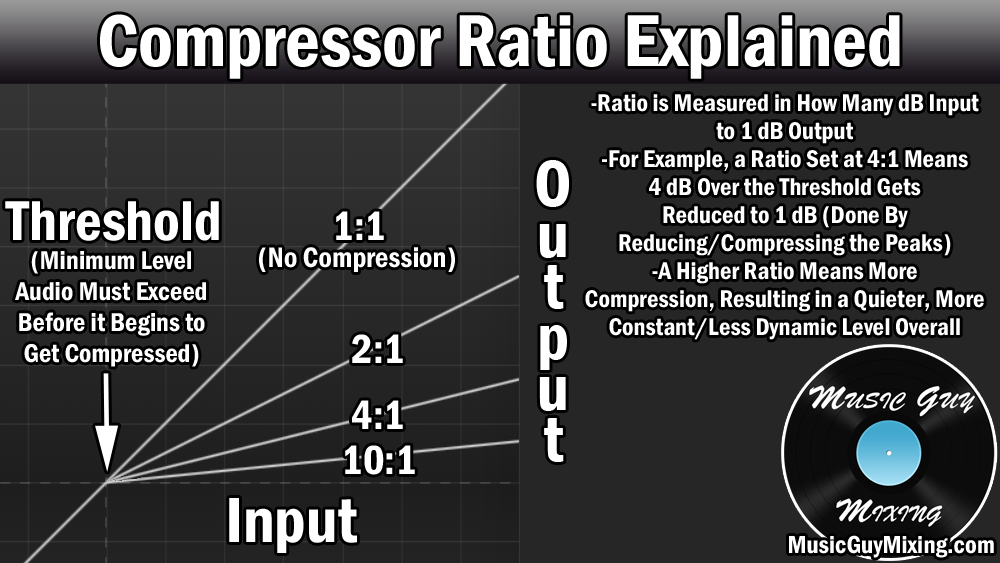
A 3:1 ratio works well on electric guitar, particularly when it’s primarily rhythm chord strumming.
If you’re compressing more of a riff or picked part, you might bump this up to a 4:1 or higher as necessary, but 3:1 just gently pushes down those peaks to create a little more cohesion in the signal.
Attack
A little delay on the compression once the threshold is met is referred to as the attack, and 5 milliseconds works well to back it off and let the front end bite and sharpness of those strings cut through before the compression smooths out the remainder of the tone and dynamics.
Release
50 milliseconds of release time to revert the signal and dynamics back to their uncompressed state is a natural release time to ease up that compression without letting the listener hear it in motion.
Threshold
Ultimately and with the above settings, I set my threshold to achieve about 3 decibels or so of gain reduction at most for compression on guitar of the electric variety when I just want a little dynamic smoothing. In combination with the rest of the settings, this typically works out to be around the average level of the guitar.
If you’ve got a part or track with individual notes, you may need to double this by lowering that threshold closer to the quietest practical level of the guitar.
You’ll also likely want to raise the ratio slightly as mentioned above as there’s typically more dynamic range associated with picked parts and you’ll want a bit more gain reduction to achieve a more consistent level via that compressor.
Compression on Acoustic Guitar
Now let’s look at acoustic guitar compression settings I like to start with on the acoustic tracks of my mix.
As I typically mention when discussing anything acoustic guitar related, admittedly there are multiple ways to feature it in a mix. Sometimes it’s pushed back and relegated to a supporting part to build out the layering and tapestry of the instrumental. In this case you probably want to or at least can get away with more aggressive settings, once again beginning with the ratio.

Ratio
I typically set the ratio on acoustic guitar compression to around 4:1 to reflect its slightly more dynamic nature relative to electric. Likewise with electric guitar, I’ll turn this up depending on the part I’m compressing.
If it’s a picked part of individual notes, I’ll aim for around 6:1 to compensate for the greater dynamic range and give that part more energy and power courtesy of that more consistent level you get from a higher ratio.
Attack
Acoustic guitar strings have more inherent transient punch than electric guitar strings (one of many differences between acoustic vs electric guitar strings).
As such, I like to back off the compression more with acoustic guitar compression by way of the attack, aiming for 25ms to maintain the punch and keep the guitar bright, punchy, and attention grabbing regardless of the compression.
Release
While the attack and ratio vary, I still like a release of 50ms to serve as a gentle yet responsive off-ramp for the compressor to ease up without trace on the guitar as it reverts to its uncompressed state.
Threshold
As I alluded to, I’m going for quite a bit more gain reduction on average with compression on acoustic guitar than electric. It will vary from track to track and strummed (less) versus picked (more) parts, but typically I’m looking for closer to 6dB in gain reduction as a sum from the rest of the settings.
With that established, I typically aim for a threshold on acoustic guitar compression to around 5-10dB below the average level so that I’m including much to all of the dynamic range.
Coupled with the attack and ratio, this helps to preserve the best elements of the tone while delivering the dynamic smoothing that I’m looking for to have it sitting much better in the mix, just like with the settings for the electric guitar.
Try either template for your respective electric or acoustic guitar track in your next mix, adjust accordingly depending on the performance, and save it as a preset in your compressor of choice to save yourself a lot of time the next time you’ve got guitar to compress while still getting it to sit just right.